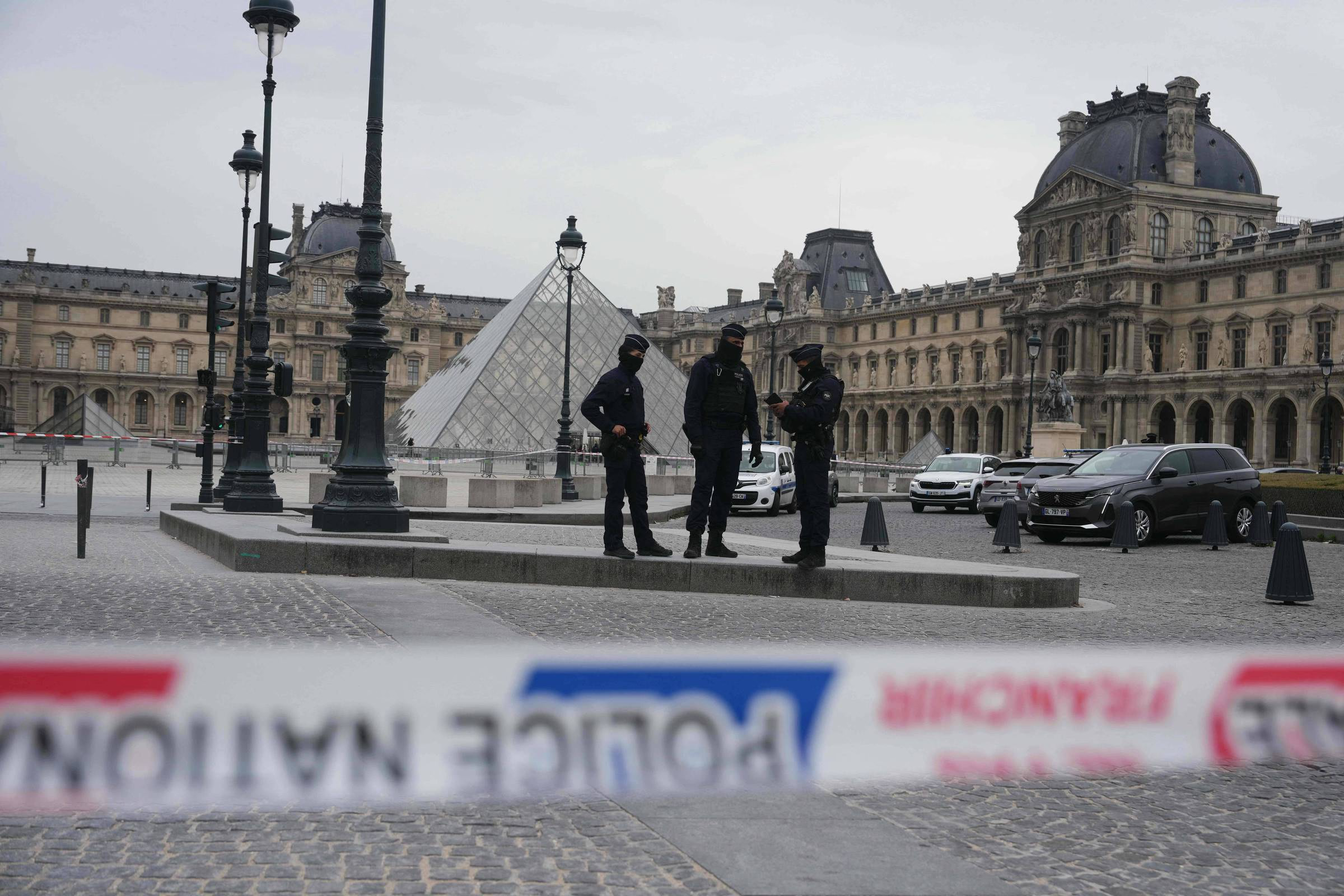
PARIS — A massive manhunt is underway in France following the brazen daylight robbery of invaluable French Crown Jewels from the Louvre Museum on Sunday morning, an operation that has exposed deep and long-standing failures in the institution’s security apparatus.
Four masked criminals executed the raid in just seven or eight minutes, making off with nine precious objects, including tiaras, necklaces, and earrings that once belonged to Empress Marie-Louise, the wife of Napoleon I, and Empress Eugénie, the wife of Napoleon III.
Justice Minister Gérald Darmanin acknowledged the government’s failure in protecting the national heritage, stating that the French people “feel as though they have been robbed.” Following an emergency meeting, the government ordered an immediate security review of the Louvre and all cultural establishments across the country.
Details of the Operation
The robbery occurred at approximately 9:30 a.m. local time on Sunday, shortly after the museum opened. The thieves targeted the Apollo Gallery, which houses the crown jewels collection.
Police reported the thieves utilized sophisticated means to breach the museum’s defenses. They reportedly parked a large removal truck behind the Louvre underneath first-floor balcony windows. Using a truck-mounted electric ladder—a device commonly used in Paris for moving bulky furniture—they climbed up to the gallery window.
They used a disc cutter or mini electric saw to cut the glass, triggering an alarm. When confronted by guards, the criminals threatened them with the cutting tool. The thieves then smashed two display cases and grabbed the artifacts, which included a royal sapphire necklace and a diadem previously worn by Empress Eugénie. In their haste, they abandoned an attempt to steal the Empress Eugénie crown, which features thousands of diamonds and emeralds.
The criminals escaped on two high-powered scooters waiting for them outside. The operation was over by 9:38 a.m.
Investigators from the Parisian police’s organized crime brigade and the Central Office for the Fight against Traffic in Cultural Goods have been mobilized, but as of Monday evening, no arrests have been made.
Long-Term Security Deficiencies
The audacity of the crime quickly brought scrutiny to the Louvre’s internal security. A preliminary report from the French Court of Audit (Tribunal de Cuentas), which had been slated for publication later this year, detailed a pattern of negligence regarding equipment upgrades dating back to 2019.
The report found a “persistent delay” in implementing security improvements and revealed a widespread lack of surveillance cameras in key areas of the massive museum, which dates back to 1190.
According to the assessment, approximately one-third of the rooms in the Denon sector—where the Apollo Gallery is located—do not have video surveillance. The situation is worse in other wings: 75% of the Richelieu sector and 60% of the Sully wing lack camera equipment entirely. Furthermore, the report pointed out that an update to the museum’s fire protection system, initiated in 2010, remains incomplete.
Christian Galani, a union representative for CGT-Culture who works at the museum, accused authorities of negligence, citing insufficient funding for security and the reduction of approximately 200 security positions over the past 15 years, even as visitor traffic increased.
Culture Minister Rachida Dati acknowledged the lapse, telling M6TV that “for too long, we worried about the safety of visitors, but not about the works of art,” and promised to accelerate necessary safety upgrades.
Thieves Likely Targeting Gems, Not History
Security experts widely suggest that the thieves were not motivated by the historical provenance of the artifacts, but rather by the inherent value of the gems and precious metals—a phenomenon dubbed “commodity theft.”
For example, a tiara stolen that belonged to Queen Hortense contained 24 Ceylon sapphires and 1,083 diamonds. Experts believe these individual stones are the primary target, as they can be dismounted, re-cut, and sold on the global market, making them virtually untraceable.
The likelihood of finding the pieces intact is considered low. High-jewelry specialists warned that the historic pieces are at high risk of being dismantled abroad, with the antique-cut diamonds likely being re-cut to suit modern tastes and divided into smaller stones to increase their anonymity and value.
This motivation may explain why the thieves bypassed highly famous and identifiable jewels also in the Apollo Gallery, such as the historic Regent and Sancy diamonds, which are generally too recognizable to be sold without raising suspicion.
This incident is the latest in a wave of high-value commodity thefts targeting museums across Europe. Similar robberies in recent years include the theft of a giant gold coin from Berlin’s Bode Museum in 2017 and a series of jewel thefts from the Green Vault museum in Dresden in 2019.