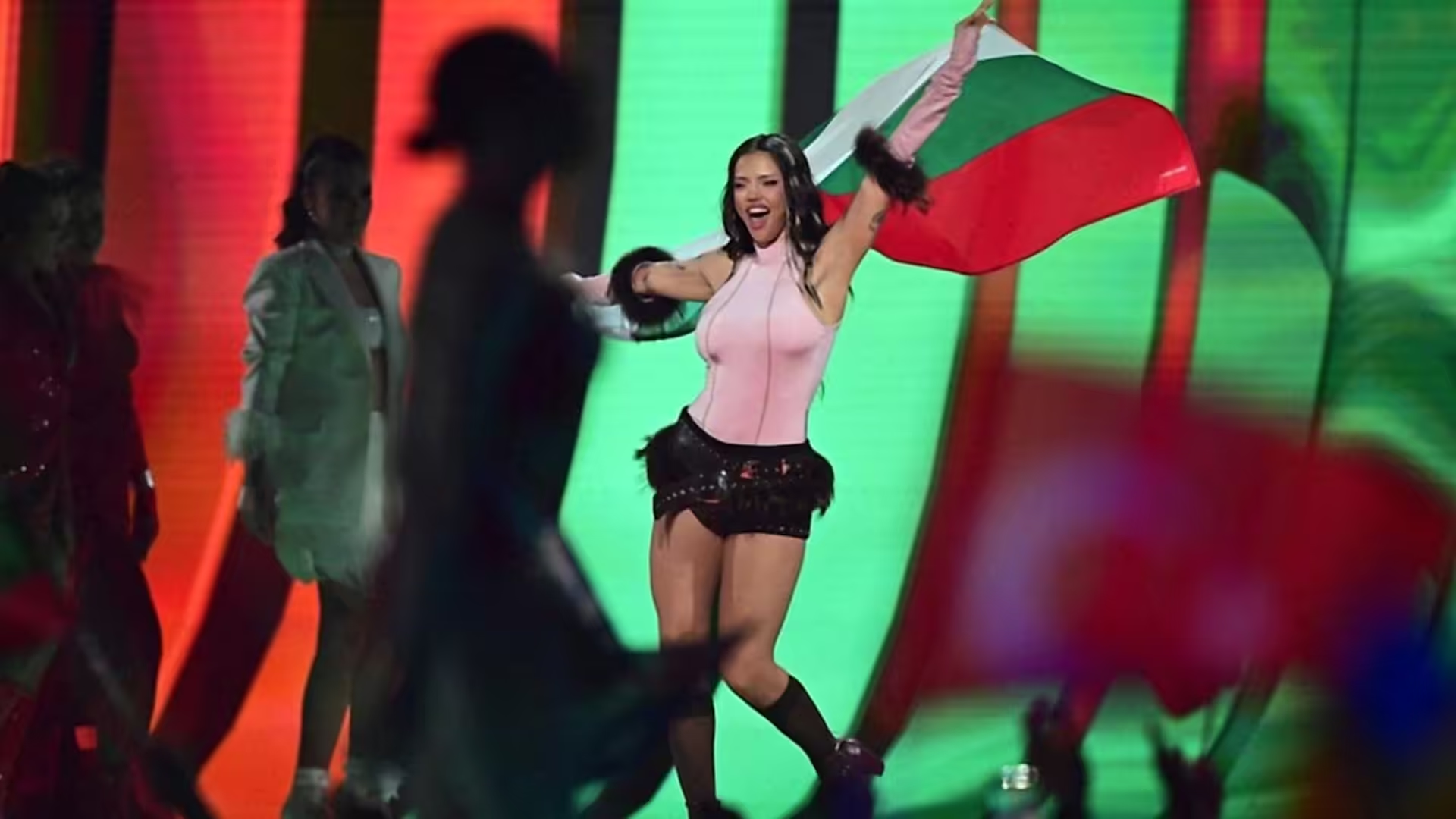
Bulgaria won the Eurovision Song Contest 2026 on Saturday in Vienna, Austria, with artist Dara performing "Bangaranga" and securing 516 total points. The victory marked Bulgaria's first win in the contest's 70-year history.
Dara received support from both national juries and public televoting. The juries awarded her 204 points, while the public contributed 312 points to her total. Israel's Noam Bettan finished second with 343 points, comprising 123 jury points and 220 public votes. Romania placed third with 296 points, Australia fourth with 287 points, and Italy's Sal Da Vinci fifth with 281 points.
The remaining top-ten finishers were Finland with 279 points, Denmark with 243 points, Moldova with 226 points, Ukraine with 221 points, and Greece with 220 points.
Dara is described as one of Bulgaria's most well-known pop musicians, known for hits including "Thunder," "Call Me," and "Mr. Rover," which dominated Bulgarian radio charts multiple times. Her songs and videos have accumulated over 80 million streams and views. She mentored musicians on the Bulgarian version of "The Voice" in 2021 and 2022. Her most recent album, "Adhdara," was released in 2025.
The contest took place at Vienna's Wiener Stadthalle amid a boycott by five countries. Spain, Ireland, the Netherlands, Iceland, and Slovenia withdrew from the competition in protest of Israel's participation. Spanish Prime Minister Pedro Sánchez stated on social media that the country would not attend but did so "with the conviction that we are on the right side of history."
The final began with a performance by JJ, the 2025 Eurovision winner, who sang selections from Mozart's "The Magic Flute" before performing his winning song "Wasted Love." Presenters Victoria Swarovski and Michael Ostrowski opened the public vote at 21:27 before the competition commenced with Denmark's Søren Torpegaard Lund performing "Før Vi Går Hjem."
Controversy surrounded the contest regarding Israel's participation and public voting patterns. Spanish broadcaster RTVE president José Pablo López characterized Eurovision director Martin Green's comments about a potential Russian return as "a flagrant insult to European values," noting that Green had stated invasion of another country should not be grounds for Eurovision exclusion. Green denied that Russia would return to the contest. López suggested Green's position reflected a "double standard with Israel."
Reports indicated that Israel's strong public vote performance drew whistles from the Vienna audience during the final vote announcement.