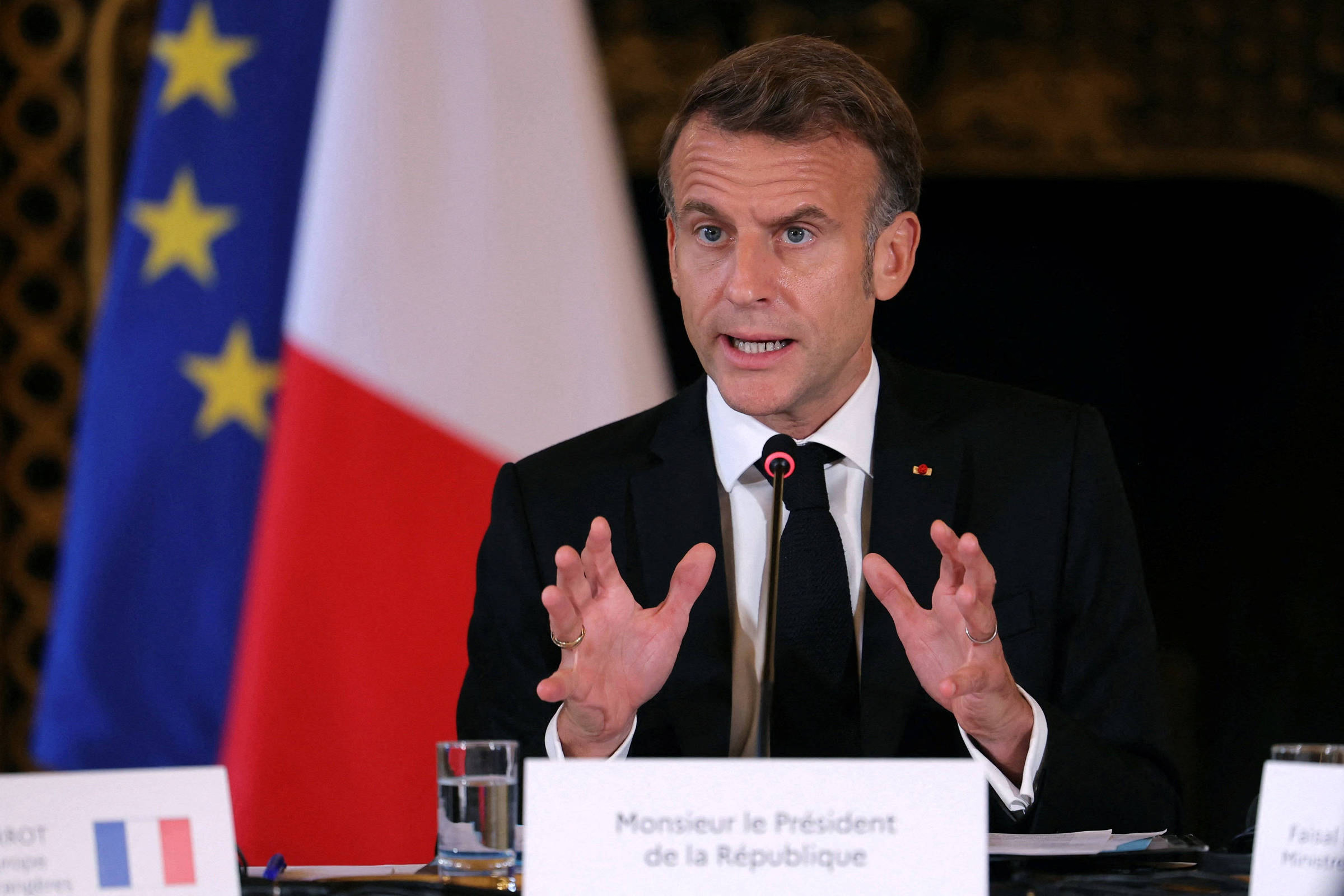
President Emmanuel Macron of France has urged political parties to foster stability amidst a national crisis, rejecting responsibility for the turbulence even as his newly appointed government braces for potential collapse.
Macron's comments, his first since Prime Minister Sébastien Lecornu’s brief resignation and subsequent reappointment, came as he departed for a summit in Egypt. The prime minister's return to office after just days in limbo has angered opponents, intensifying concerns about further instability as France races to pass a deficit-cutting budget by year's end.
"It is everyone’s duty to work toward stability, not to bet on instability," Macron told reporters, emphasizing his desire for France to "move forward in peace, stability, seriousness."
However, achieving this goal appears challenging. The far-right National Rally and the far-left La France Insoumise have already announced their intention to file no-confidence motions against Lecornu, who is slated to deliver a key policy speech in the 577-seat lower house of Parliament on Tuesday. Support from other opposition parties could bring Lecornu perilously close to the 288 votes required to topple his government.
The lower house of Parliament is currently fragmented among three main blocs: left-wing parties, a coalition of conservatives and centrists, and the nationalist, anti-immigration far right. Lawmakers are expected to vote on the no-confidence motions this week. If successful, Lecornu and his cabinet would be forced to resign, placing further pressure on Macron to call snap parliamentary elections or even to step down himself.
The National Rally stated that "only by returning to the people will it be possible to make the major political decisions needed to overcome these multiple crises." Polls suggest the National Rally would be the primary beneficiary of new elections.
Macron, who has ruled out resigning or calling new elections, criticized French political parties for engaging in squabbles at a critical juncture. "Many of those who have fueled division and speculation have not been up to the task of the current situation in France and of the French people’s expectations," he said, holding those who "destabilized" Lecornu solely responsible for the "disorder."
"I ensure continuity and stability, and I will continue to do so," Macron added.
Critics, including some within his own party, accuse Macron of prolonging the crisis. His centrist alliance suffered significant losses in snap elections last year, yet he has consistently appointed center-right minority governments rather than an opposition prime minister. Le Monde questioned in an editorial whether Macron has "realized that he must step down from his own second term, at least regarding domestic policy, to salvage what remains?"
Under the French Constitution, the president appoints the prime minister, who then forms a cabinet. The prime minister is responsible for domestic policy and day-to-day governance.
The cabinet appointed on Sunday, comprising members from Macron's centrist coalition, conservatives, and independent figures, did not represent a radical departure from the previous government. Key ministers such as Foreign Minister Jean-Noël Barrot and Economy Minister Roland Lescure retained their positions. Bruno Le Maire, who had drawn criticism for his appointment as defense minister, did not return to the cabinet.
Six ministers in the 34-member cabinet came from the mainstream conservative party, Les Républicains. However, the party's leader, Bruno Retailleau, announced that all six would be expelled from the party, signaling a deepening rift over cooperation with Macron.
Laurent Nuñez, the former Paris police chief and head of France's counterterrorism and intelligence services, has been appointed interior minister, replacing Retailleau. Jean-Pierre Farandou, the head of France's national rail company, is now the labor minister, and Monique Barbut, former head of the World Wildlife Fund in France, has been appointed environment minister.
Lecornu had previously emphasized the need for new faces disconnected from presidential ambitions for the 2027 elections. He informed his first cabinet meeting on Monday that their primary mission was to "overcome this political crisis in which we find ourselves and that has stunned some of our fellow citizens."
Mathilde Panot, a leading lawmaker for La France Insoumise, wryly advised newcomers not to "unpack your boxes too quickly."
The new government faces the immediate challenge of surviving the week and then passing a budget for 2026 to address France's rising public debt, which reached 115.6% of GDP in June. The current political turmoil stems from Macron's decision in June 2024 to dissolve the National Assembly and call early legislative elections following his party's poor performance in the European Parliament elections, a move that resulted in a fragmented Parliament lacking an absolute majority.