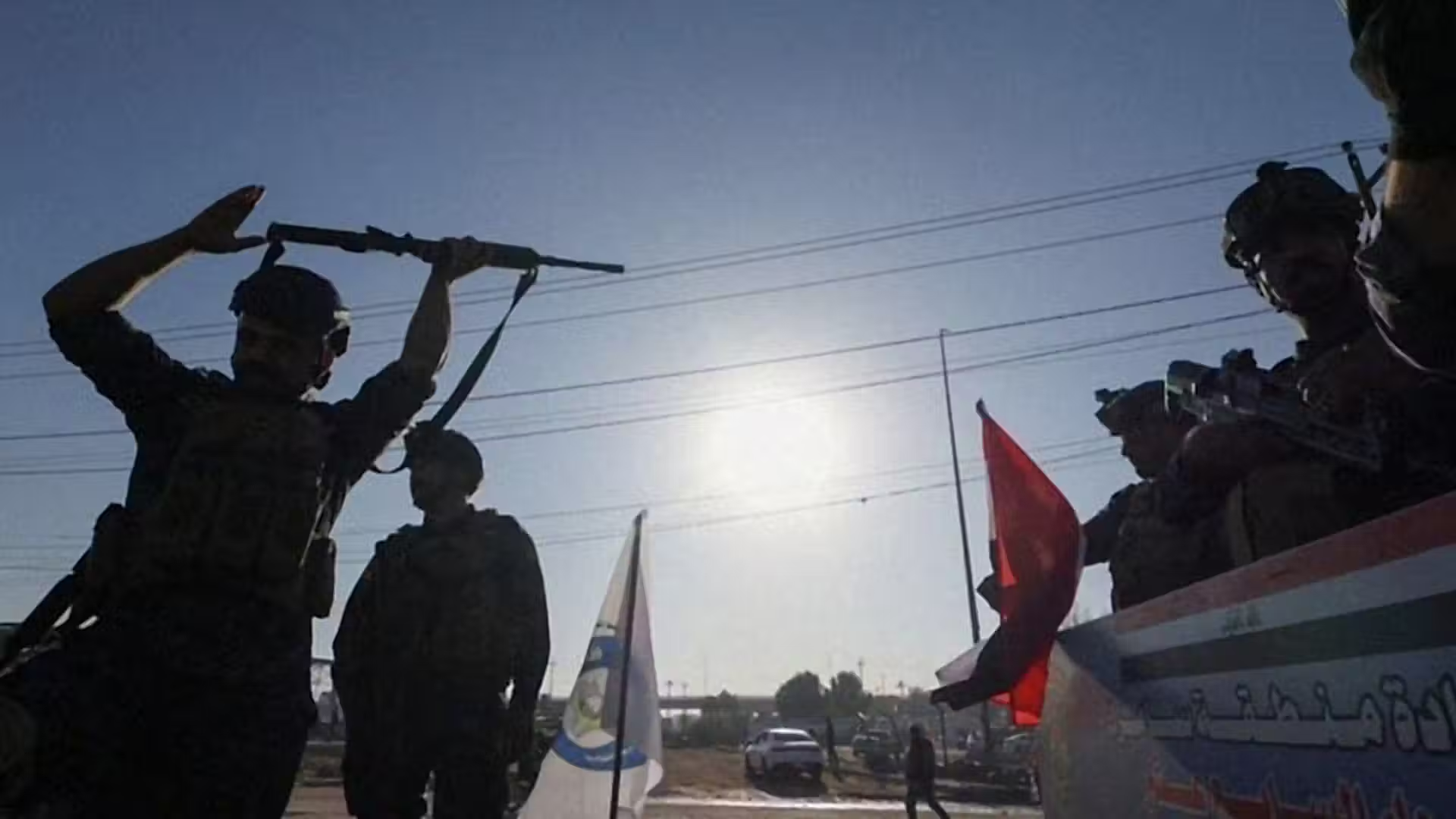
Iraqi security forces deployed in Jurf al-Sakhar on Friday, a stronghold of the Iran-backed Kataib Hezbollah militia, under a deal brokered by Shi'ite politicians that seeks to limit the reach of Iran's most powerful armed ally in the country without provoking direct confrontation.
Prime Minister Ali al-Zaidi ordered the operation this week against Kataib Hezbollah, which officials accused of running an oil smuggling network siphoning state-owned oil worth hundreds of millions of dollars from the city in Babil province, about 50 kilometers south of Baghdad. Kataib Hezbollah, branded a terrorist group by the United States, rejected the smuggling accusations. The arrests that followed prompted fears of an armed response from the group.
A convoy of vehicles flying Iraqi flags moved toward Jurf al-Sakhar on Friday and soldiers took up positions in the center after senior Iraqi security officials announced that government forces would protect the city. "From Jurf al-Sakhar, we begin asserting state authority across all of Iraq, confronting corruption and weapons beyond state control," Zaidi said from a joint military operations center in Baghdad. "Our decision is firm: No weapons outside state authority, no weapons but Iraq's, no decisions but Iraq's, and no flag shall fly higher than the Iraqi flag."
Under the arrangement, Kataib Hezbollah members were expected to withdraw to other parts of Iraq. A security headquarters will open in Jurf al-Sakhar on Saturday to oversee the handover. Iraq's energy police have begun securing an oil pipeline in the city, the state news agency reported.
"Today is a historic moment in which the Iraqi Armed Forces prove that they are the nation's shield, safety valve, and the guardian ensuring security stability for the Iraqi people," Sabah al-Numan, spokesperson for the commander-in-chief of the Iraqi armed forces, said at a press conference.
Esmail Qaani, commander of Iran's Revolutionary Guards' Quds Force, arrived in Baghdad on Monday to help defuse tensions with Kataib Hezbollah, according to Iraqi Shi'ite political figures. Nine senior security and oil officials have been dismissed following an investigation focused on Jurf al-Sakhar.
Kataib Hezbollah, founded after the 2003 U.S.-led invasion of Iraq, is among the most influential members of the Islamic Resistance in Iraq, an umbrella group of hardline Shi'ite armed organizations supported by Iran. The group has thousands of hardened fighters and forms several battalions in Iraq's Popular Mobilization Forces, a grouping of armed factions set up in 2014 to fight Islamic State and subsequently recognized as an official security force. Kataib members, including some designated as terrorists by the U.S., hold senior positions in the PMF.
U.S. President Donald Trump has pressured Zaidi to disarm the militias that have struck U.S. troops and facilities in Saudi Arabia and the United Arab Emirates in solidarity with Tehran since the United States and Israel launched attacks on Iran in late February. Kataib Hezbollah and other militias, all of whom report directly to Iran's Revolutionary Guards, have refused to hand over their weapons to the state. The group is among those that have claimed attacks on U.S. forces in Gulf states since the start of the U.S.-Israeli war on Iran.