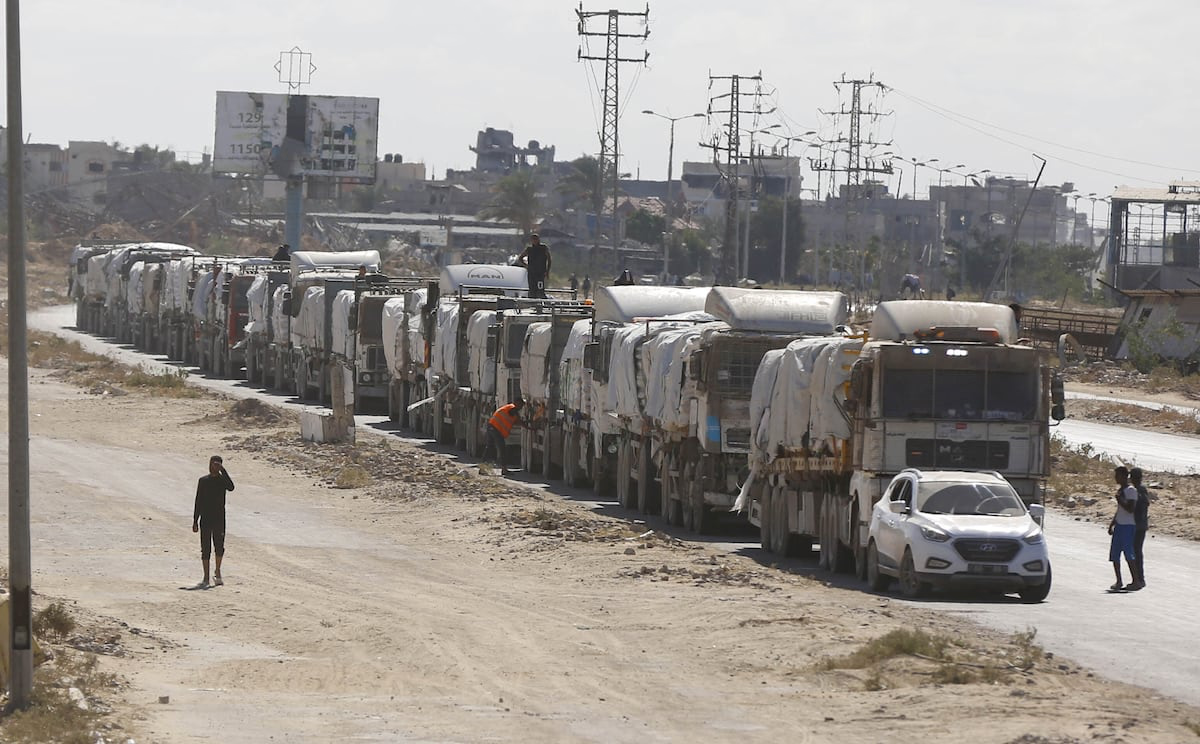
Israel has significantly reduced the flow of humanitarian aid into Gaza and will maintain the closure of the Rafah border crossing with Egypt, according to officials, escalating pressure on Hamas in retaliation for the pace at which the group is returning the bodies of hostages killed during the conflict.
The United Nations confirmed that Israeli authorities have notified them that only 300 aid trucks will be permitted to enter Gaza daily, a reduction from the previously agreed-upon 600. Furthermore, no fuel shipments will be allowed into the territory, except for essential humanitarian infrastructure needs. This decision marks a stark departure from the broader humanitarian provisions outlined in the recent ceasefire and hostage exchange agreement.
The Israeli government stated that this punitive measure is a direct response to Hamas's failure to fulfill its commitment to return the bodies of all deceased Israeli hostages. While Hamas returned four bodies on Monday—three Israelis and one Nepali—and has committed to returning four more, Israel considers this insufficient and is treating it as a violation of the pact. Families of the hostages and right-wing ministers within the Israeli cabinet are also reportedly pressuring Prime Minister Netanyahu to suspend the ceasefire agreement entirely until all bodies are returned.
The hostage exchange, which saw the return of the last 20 living hostages in exchange for the release of nearly 2,000 Palestinian prisoners, had initially been met with widespread relief. However, the subsequent challenges in implementing the agreement's humanitarian aspects have quickly surfaced, highlighting the fragility of the truce.
International aid agencies have expressed concern over the situation. The International Committee of the Red Cross (ICRC) acknowledged the immense difficulty in locating and recovering bodies amidst the devastation in Gaza, warning that the process could take days or weeks, and some bodies might never be found. A spokesperson for the UN Office for the Coordination of Humanitarian Affairs (OCHA) in Gaza confirmed the notification from Israeli authorities and urged both parties to adhere to the ceasefire agreement's parameters.
In parallel to the aid restrictions, Israeli forces reported engaging Palestinian individuals who approached their lines in northern Gaza, resulting in multiple fatalities according to health authorities in the territory. The Israeli military stated these individuals had crossed a designated withdrawal line and disregarded calls to retreat.
The ceasefire agreement, brokered with the involvement of the United States, Qatar, and Egypt, also includes provisions for the future governance of Gaza and the potential disarmament of Hamas. However, these more complex phases of the negotiation are proving to be challenging, with mediators admitting that the urgency to secure the return of living hostages led to the deferral of discussions on these critical issues.
Hamas has reportedly shown increasing authority in Gaza streets, with armed militants taking on security and governance tasks. This includes efforts to clear debris for aid delivery. Reports also indicate Hamas has launched a campaign against a local clan, the Dogmush, who allegedly collaborated with Israel. Videos circulating on social media show alleged Hamas militants executing seven men accused of collaboration.
Amidst these developments, U.S. President Donald Trump, who played a key role in brokering the agreement, reiterated on social media that "the work IS NOT YET DONE" and that the "DEAD HAVE NOT BEEN RETURNED, AS PROMISED!"
The restrictions on aid come as Gaza faces a severe humanitarian crisis, with agencies emphasizing the urgent need for substantial and consistent supplies to alleviate suffering and prepare for the winter months.