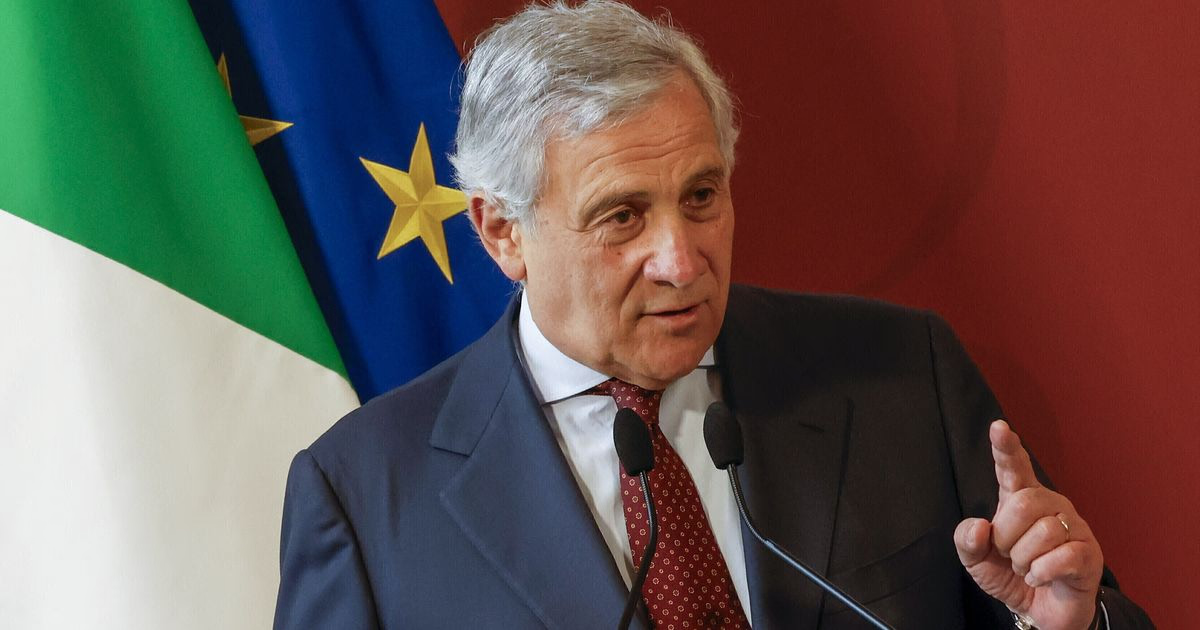
Rome, Italy – Italian Foreign Minister Antonio Tajani has characterized President Trump's newly agreed-upon peace plan for Gaza as a potential "historic turning point" for the Middle East, while simultaneously urging caution due to the many unresolved aspects of the agreement.
Speaking to both the Chamber of Deputies and the Senate, Tajani expressed a sentiment of "relief and hope" following the ceasefire in Gaza and the release of hostages. He stated that the peace initiative could fundamentally alter the geopolitical landscape of the Middle East and the wider Mediterranean region.
"The success of the peace initiative launched by the US president could truly contribute to a historic turning point that changes the face of the Middle East, with repercussions also on national security and interests," Tajani told reporters upon arriving at the Chamber.
However, the minister emphasized that the plan's success is "still tied by a thread," with numerous variables yet to be defined. He highlighted the ongoing presence of Hamas as a significant obstacle.
Regarding the prospect of a Palestinian state, Tajani indicated that recognition is now "closer" when conditions, including those previously set by the Italian Parliament, are met. He described the desired state as "true, democratic, peaceful, non-confessional, entrusted to a Palestinian National Authority profoundly renewed in its people and methods."
Italy has been actively involved in humanitarian efforts for Gazans, focusing on healthcare, food security, and education. Tajani announced the provision of an additional 100 tons of aid from Italy's agri-food sector and pledged continued support, seeking to involve the private sector in addressing what he termed a "challenge of epic proportions."
A key focus moving forward is the reconstruction of the Gaza Strip. A government meeting was scheduled to discuss this crucial aspect, with Tajani underscoring the need to consolidate conditions for lasting peace and the prospect of two states coexisting in security.
Ambassador Bruno Archi, Italy's permanent representative to the UN in Rome, has been appointed as the special envoy for reconstruction efforts in Gaza.
On the matter of an international stabilization force in Gaza, as outlined in Trump's plan, Italy is prepared to contribute military personnel. Tajani cited Italy's extensive experience in complex international operations as a strong basis for participation. He assured that Parliament would be involved in all decisions concerning Italy's potential role in such a force, expressing hope for political unity on the issue.
Tajani also commented on recent clashes in Udine, Italy, where pro-Palestinian extremists reportedly attacked law enforcement attempting to prevent an Italy-Israel football match. He voiced solidarity with injured journalists and law enforcement officers, reiterating that "antisemitism must be fought everywhere and in every way with all strength."
He acknowledged the immense suffering on both sides of the conflict, noting the Israeli desire for the return of hostages and the plight of Palestinians in Gaza enduring a "terrible conflict." Tajani also pointed out that Israel "did not want to adopt the attention and precautions imposed by international humanitarian law."
Tajani described the current global attention and media coverage as having "unprecedented symbolic value," recognizing a widespread sincere passion for peace. However, he also noted instances of "instrumentalization and sensationalism for antisemitic prejudice."
In a broader regional context, Tajani views the agreement signed in Sharm el-Sheikh as a foundational element for regional stabilization, supported by a "new season of the Abraham Accords" aimed at normalizing relations. He emphasized the Middle East's critical role in the international arena and the imperative to look towards a future of peace.
Furthermore, Tajani revived the initiative for an "Olympic Truce" in anticipation of the Milan-Cortina Winter Games, seeing it as a significant political endeavor to bolster the spirit of the American plan at the United Nations.
Meanwhile, some observers expressed reservations. Diana Buttu, a lawyer and former adviser to the Palestine Liberation Organization, voiced concerns that the agreement might simply "paper over" the harm caused by decades of occupation without addressing its root causes. She highlighted the lack of guarantees for Palestinians and the negotiation process itself, describing it as Palestinians being forced to negotiate an end to what many international bodies have described as genocide.
Buttu also noted a disconnect between the U.S. plan, which she characterized as an Israeli plan rebranded, and the aspirations of Palestinians for freedom and an end to the occupation. She pointed out that the plan does not envision an immediate Palestinian state and leaves Israel with significant control over Gaza's future, including decisions on what and how much aid enters the strip.