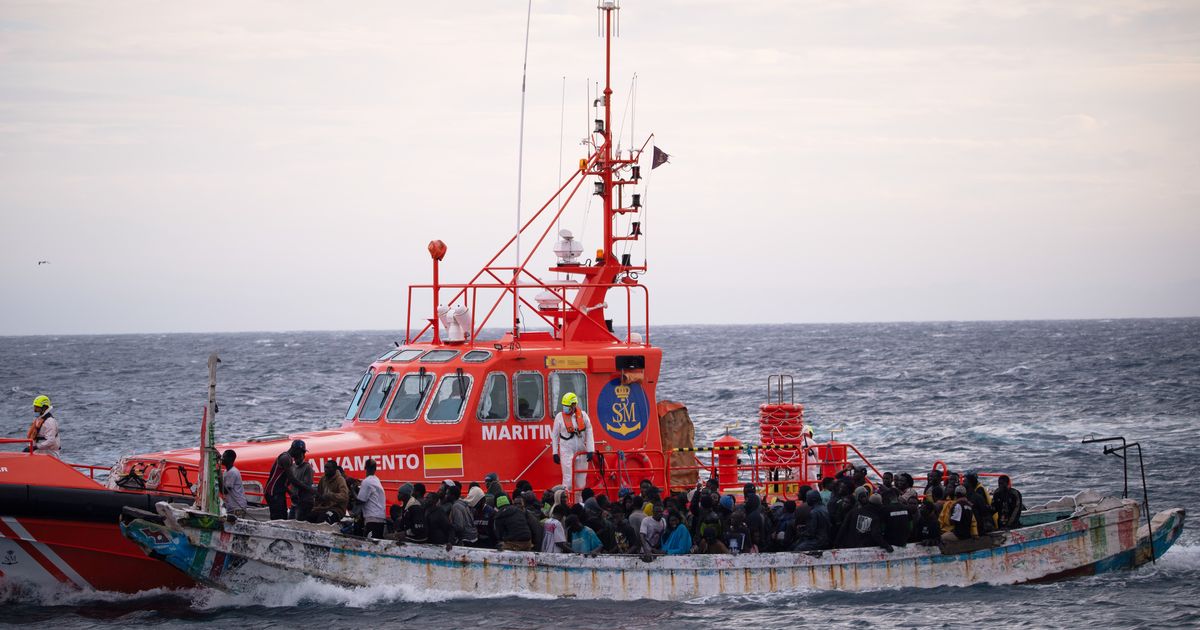
Nearly 2,000 migrants arrived at Spain's Canary Islands on Tuesday, setting a single-day record for arrivals at the archipelago, Spanish authorities said.
Spain's maritime rescue service said 1,990 people arrived on 15 different boats at the island of El Hierro, according to one account, while the Spanish coastguard recorded 2,121 arrivals, according to another. The discrepancy in figures reflects different counting methods by authorities. Among the arrivals were around 100 minors, including a four-day-old baby born during the journey, and one deceased migrant.
El Hierro, the westernmost of the Canary Islands, has a population of 12,000. Fernando Clavijo, the Canary Islands' regional leader, said the island could not handle such a large influx. "Sadly, this is a historic day," Clavijo said in an interview with Spanish radio Cadena Ser. "The sailing conditions were favourable and there was a full moon, so these people looking for a better future ended up on our shores."
Most of the boats that arrived Tuesday were from Senegal and Gambia. The crossing from West Africa spans more than 800 nautical miles and can take a week or longer. The route is extremely dangerous, with more than one in 20 migrants dying or disappearing at sea.
Over 26,000 people have reached the Canary Islands this year, with half that total arriving in November. The previous single-day record was 1,400 people on Nov. 7, and before that 1,580 on Nov. 14. Departures from West Africa are seasonal, with November typically seeing spikes as migrants leave before winter ocean conditions worsen.
The arrivals come days before Spain holds a national election Sunday, when migration will be a major concern for voters. The conservative Popular Party is aiming to unseat the ruling Socialist-led government and would likely need to form a coalition with the far-right Vox party, which is campaigning heavily on expelling migrants. Clavijo, who belongs to the regional Canary Coalition party, denounced what he called "a xenophobic discourse of bad people" in response to the arrivals.
In October, Madrid declared a state of emergency in the Canary Islands and released additional funds to expand reception facilities. Clavijo said he was satisfied with the transfer of adult migrants to mainland Spain but asked for help from other regions to care for unaccompanied minors.