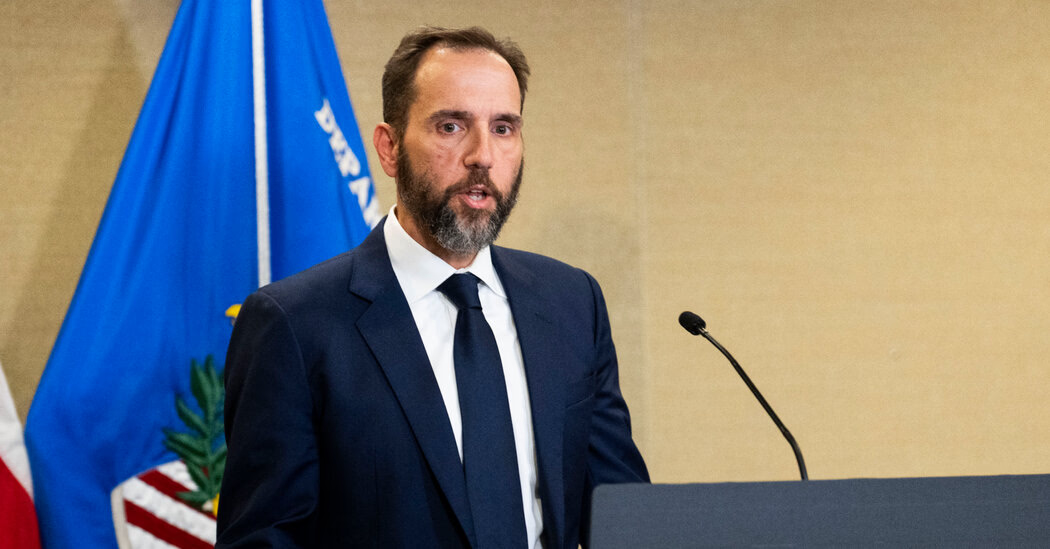
Lawyers for former Special Counsel Jack Smith have strongly denied accusations by Republican lawmakers that Smith’s team spied on or wiretapped members of Congress during the investigation into efforts to overturn the 2020 presidential election.
In a letter to Senator Charles E. Grassley (R-Iowa), Smith’s attorneys, Lanny Breuer and Peter Koski, stated that the special counsel’s actions were “entirely lawful, proper and consistent with established Department of Justice policy.”
Senator Grassley, Chairman of the Senate Judiciary Committee, accused Mr. Smith earlier this month of “spying” on legislators after it was revealed that the FBI, working under the special counsel, sought historical phone records for calls to and from nine Republican politicians during a four-day period around the Jan. 6, 2021, Capitol riot.
Clarifying the Scope of the Records
Lawmakers, including Senator Josh Hawley (R-Missouri), have publicly urged the Justice Department to open an internal investigation into Smith’s conduct, claiming he used grand jury subpoenas to surveil members of Congress.
Smith’s legal team pushed back sharply on the terminology, stressing the difference between a wiretap and the records obtained. “A number of people have falsely stated that Mr. Smith ‘tapped’ senators’ phones, ‘spied’ on their communications, or ‘surveilled’ their conversations,” the lawyers wrote. They explained that the subpoena obtained “toll records,” which are historical in nature and only include telephonic routing information—such as incoming and outgoing call numbers, time, and duration—but crucially, they do not include the content of the conversations.
“Wiretapping, by contrast, involves intercepting the telecommunications in real time, which the special counsel’s office did not do,” the attorneys emphasized.
Investigative Justification
The phone records obtained in 2023 related to communications made between January 4 and January 7, 2021. According to the special counsel’s defense, these records were sought as part of an effort to "confirm or refute reports by multiple news outlets that during and after the Jan. 6 riots at the Capitol, President Trump and his surrogates attempted to call senators to urge them to delay certification of the 2020 election results.”
The precise records were also produced in discovery to the legal team of President Donald J. Trump, officials noted.
The list of lawmakers whose records were scrutinized included eight Republican senators—Lindsey Graham (R-South Carolina), Bill Hagerty (R-Tennessee), Josh Hawley (R-Missouri), Dan Sullivan (R-Alaska), Tommy Tuberville (R-Alabama), Ron Johnson (R-Wisconsin), Cynthia Lummis (R-Wyoming), and Marsha Blackburn (R-Tennessee)—as well as Representative Mike Kelly (R-Pennsylvania).
Call for Internal Investigation
In response to the disclosure, several senators wrote to Attorney General Pam Bondi asking for an investigation into Smith, claiming he was a “rogue Special Counsel” who took “concerted steps to spy on duly elected members of Congress.” This political pressure came alongside reports that two FBI agents involved in the investigation were fired recently.
Smith’s lawyers countered the assertion that his investigative work was kept secret, arguing that the subpoenas were issued in an "entirely lawful and appropriate manner."
They further noted that obtaining telephone toll records via subpoena is a routine investigative step that has been used in other high-profile Justice Department cases, including when Special Counsel Robert Hur obtained records related to President Biden and when the Trump administration obtained similar records from then-Representatives Eric Swalwell and Adam Schiff during an investigation into media leaks.