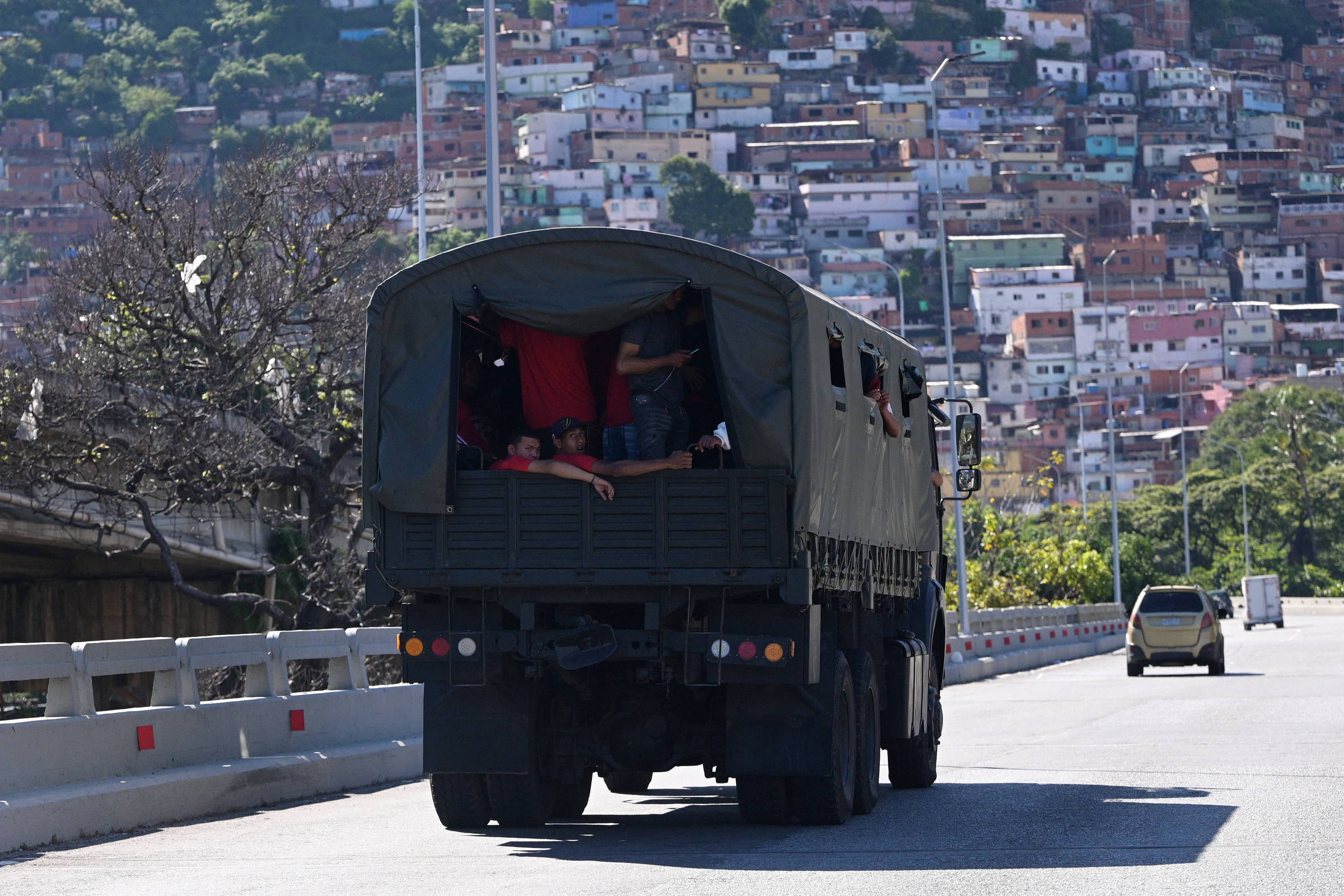
President Nicolás Maduro of Venezuela has ordered military exercises to be conducted in the nation's largest shantytowns, a move that follows a series of U.S. military strikes on boats in the Caribbean that the U.S. alleges were involved in drug trafficking.
Maduro announced the mobilization of popular defense, military, and police forces on Wednesday, stating it was a response to what his government calls a threat to regional peace. State television broadcast images of armored vehicles being deployed in Petare, a densely populated area in the Caracas metropolitan region, and drills are also planned for the neighboring Miranda state, home to approximately 7 million people.
These actions come after the U.S. military reported striking another vessel off the Venezuelan coast on Tuesday, resulting in six fatalities. This incident brings the total number of deaths in such attacks, which began on September 2, to at least 27.
U.S. officials assert that the targeted vessels were trafficking narcotics and were operating on known drug routes in international waters. President Trump has deployed warships, a submarine, and fighter jets to the Caribbean as part of an operation aimed at combating drug smuggling into the United States. The White House has identified the targeted boats as being linked to the Tren de Aragua faction, which the Trump administration has designated as an international terrorist organization.
Venezuela's government has accused the U.S. of orchestrating a campaign for regime change and attempting to seize its natural resources. Diosdado Cabello, Venezuela's Interior Minister, described the U.S. actions as an attempt to "rob" the nation.
The Trump administration has also offered a $50 million reward for information leading to Maduro's capture, accusing him of heading the drug cartel known as Cartel de los Soles, an accusation Maduro denies.
Adding to the escalating tensions, the Trump administration has secretly authorized covert CIA action in Venezuela. U.S. officials, speaking on condition of anonymity, stated that this authorization allows for lethal operations and a range of activities in the Caribbean, either unilaterally or in conjunction with larger military operations. While it remains unclear if the CIA has immediate plans for such operations, the authority signifies a stepped-up campaign against Maduro.
This development occurs as the U.S. military is reportedly drawing up options for further escalation, including potential strikes within Venezuela. The U.S. military presence in the region has significantly increased, with approximately 10,000 troops stationed, primarily in Puerto Rico, alongside a contingent of Marines on amphibious assault ships. The Navy also has eight warships and a submarine deployed in the Caribbean.
President Trump ended diplomatic talks with the Maduro government this month, expressing frustration over Maduro's refusal to relinquish power and his continued denial of involvement in drug trafficking. U.S. intelligence assessments have reportedly contradicted the administration's assertion that Maduro controls the Tren de Aragua gang.
The U.S. strategy, reportedly developed with the involvement of Secretary of State Marco Rubio and CIA Director John Ratcliffe, aims to oust Maduro from power. Ratcliffe has indicated a more aggressive approach for the CIA, willing to conduct covert actions.
Historically, the CIA has engaged in covert operations in Latin America and the Caribbean, with mixed outcomes, including orchestrating a coup in Guatemala in 1954, the Bay of Pigs invasion of Cuba in 1961, and involvement in coups in Brazil and Chile, as well as supporting the contra fight in Nicaragua.