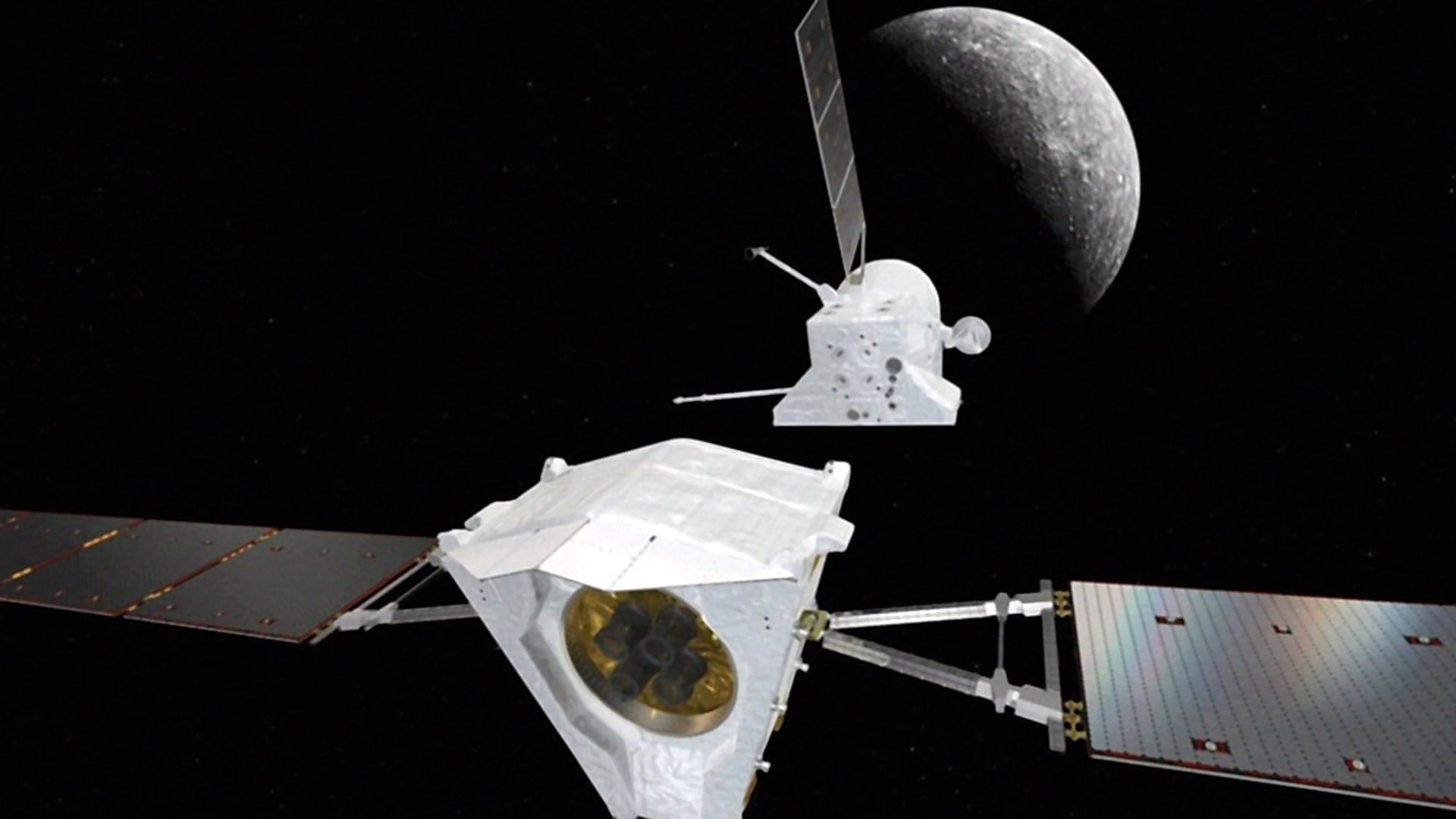
The European Space Agency's BepiColombo spacecraft successfully entered orbit around Mercury on Saturday after eight years traveling through the inner solar system.
BepiColombo is a joint mission led by ESA in collaboration with Japan's Aerospace Exploration Agency (JAXA). It will be the first mission to orbit Mercury with two spacecraft simultaneously: ESA's Mercury Planetary Orbiter (MPO) and JAXA's Mercury Magnetospheric Orbiter (Mio).
The spacecraft's Mercury Transfer Module separated from the stack on September 3, 2026, allowing the two science orbiters to proceed toward their destination. The composite spacecraft entered Mercury orbit on November 21, with MPO and Mio scheduled to separate from each other on December 9-10.
MPO's instruments have been activated and tested since the transfer module's separation. On September 15, all instruments on MPO were switched on together for the first time. The laser altimeter BELA fired its laser over 21.5 hours, emitting more than 700,000 pulses into open space. The Mercury Radiometer and Thermal Imaging Spectrometer (MERTIS) received around 1 gigabit of data during a 22-hour science performance test. The science camera SIMBIO-SYS activated its three optical channels and successfully captured its first image in space.
On September 24, MPO tested its axial thrusters for the first time after separating from the transfer module, firing for 8 minutes and 42 seconds and achieving a precise push of 11.4 meters per second.
The BepiColombo Mission Control Team completed extensive simulations in preparation for the arrival sequence. The rehearsals covered every major step including the transfer module separation, orbit insertion, and the planned separation of the two science orbiters.
The mission's science phase is set to begin in April 2027. The €1.7 billion project aims to study Mercury's magnetic field, surface, core and thin atmosphere.