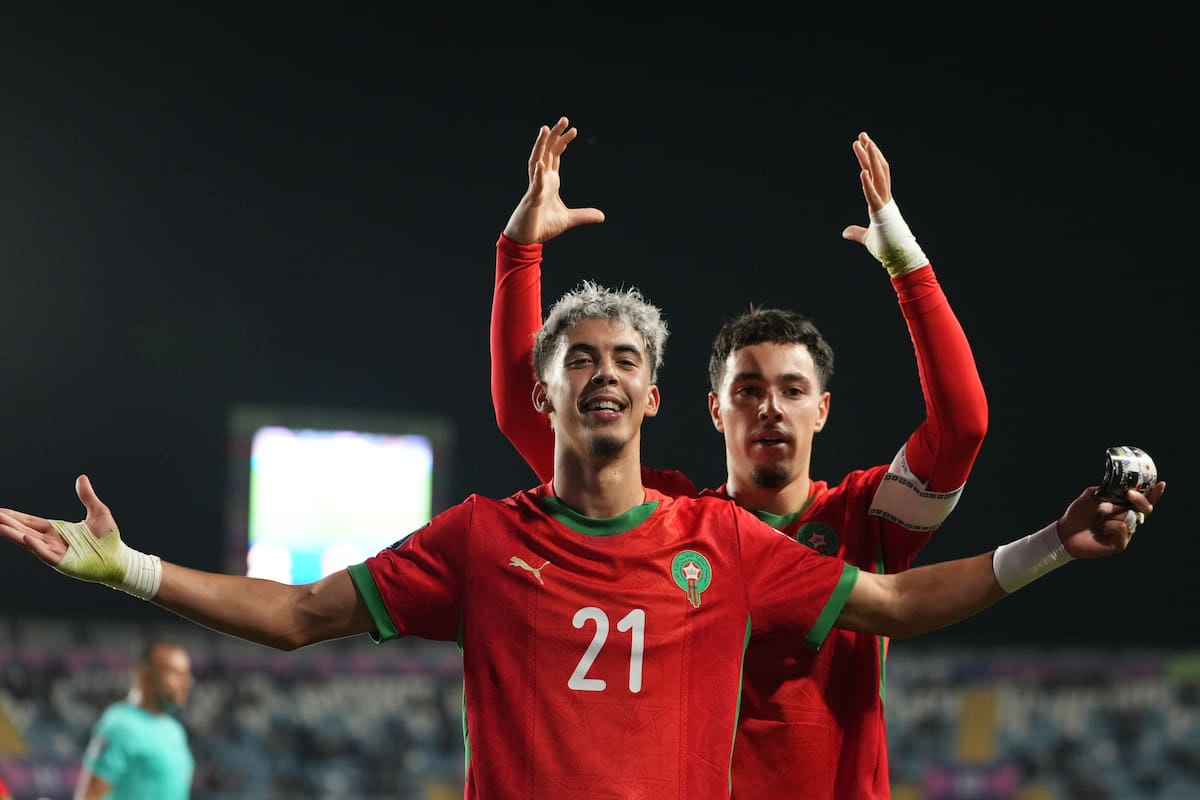
Morocco clinched its first-ever FIFA U-20 World Cup title on Sunday, defeating pre-tournament favorites Argentina 2-0 in the final held at the Estadio Nacional Julio Martínez Prádanos in Santiago, Chile. Forward Yassir Zabiri scored both goals in the first half to secure the historic victory for the North African nation.
The final match was played in front of a sold-out stadium, with many Argentine supporters present in the Chilean capital. Morocco, guided by coach Mohamed Ouahbi, employed a quick-paced, counter-attacking strategy that quickly unsettled the Argentine side coached by Diego Placente.
Decisive First Half
The African team demonstrated their intent early, with powerful runs down the flanks, often led by Othmane Maamma. The opening goal came in the 12th minute after Argentine goalkeeper Santino Barbi was penalized for a foul outside his area during a Moroccan attack, resulting in a yellow card and a dangerous free kick.
Zabiri converted the resulting set piece with precision, curling a powerful shot into the angle past the goalkeeper's reach to make it 1-0. Argentina, a nation pursuing its seventh U-20 crown, attempted to respond, but lacked sharpness in the final third.
Morocco doubled its lead in the 28th minute through a devastating counter-attack. Maamma skillfully advanced the ball down the right wing, stopped, and delivered a perfect cross to the far post. Zabiri met the ball with a first-time, left-footed strike to put the score at 2-0, a lead the Moroccans held until halftime.
Argentina’s Efforts Rebuffed
Argentina made multiple changes at the start of the second half, increasing pressure on the Moroccan defense, which largely retreated into its own area to protect the advantage. Although Argentina dominated possession and controlled the final 45 minutes, they struggled to find clear scoring opportunities.
Attempts by players like Gianluca Prestianni and Ian Subiabre were either saved by the Moroccan goalkeeper or missed the target. Argentine players and the bench repeatedly appealed to the Italian referee, Maurizio Mariani, for potential penalties—including a review for a tackle on Alejo Sarco and a late shout for a handball—but officials determined that the contact was routine and upheld the 2-0 scoreline.
As the game wore on, tensions flared briefly when Othmane Maamma was substituted late, departing slowly and engaging in a minor confrontation with Argentine players who were eager for the game to resume quickly. Subiabre received a yellow card for pushing the departing player.
Morocco’s defense remained firm until the final whistle, clinching the title and concluding a successful tournament in which they topped a challenging Group C that included Brazil and Spain, and later eliminated major European powers such as the United States and France in the knockout rounds.
The Rise of Moroccan Football
This U-20 triumph reflects the success of a major long-term national investment program aimed at elevating Moroccan football across all categories. The nation, often leveraging its global diaspora, has been systematically incorporating players formed in European leagues into its youth teams.
Ten players on the title-winning U-20 squad were born outside of Morocco, a strategy that mirrored the senior national team’s historic run to the World Cup semifinals in 2022.
Under the direction of King Mohamed VI, the Moroccan Royal Football Federation (FRMF) has heavily financed football development, including the inauguration of the Mohammed VI Football Academy near Rabat, a high-performance center built to train future stars and prevent African talent from being entirely absorbed by European selections. Officials cited the extensive backing and national support as vital factors providing the young players with the morale necessary for success.