Trump announces military coalition against drug cartels at Miami summit with Latin American right-wing leaders
Trump unveiled a new military coalition to combat cartels during the Shield of the Americas summit in Miami, attended by 12 right-aligned Latin American leaders.
4 hrs ago
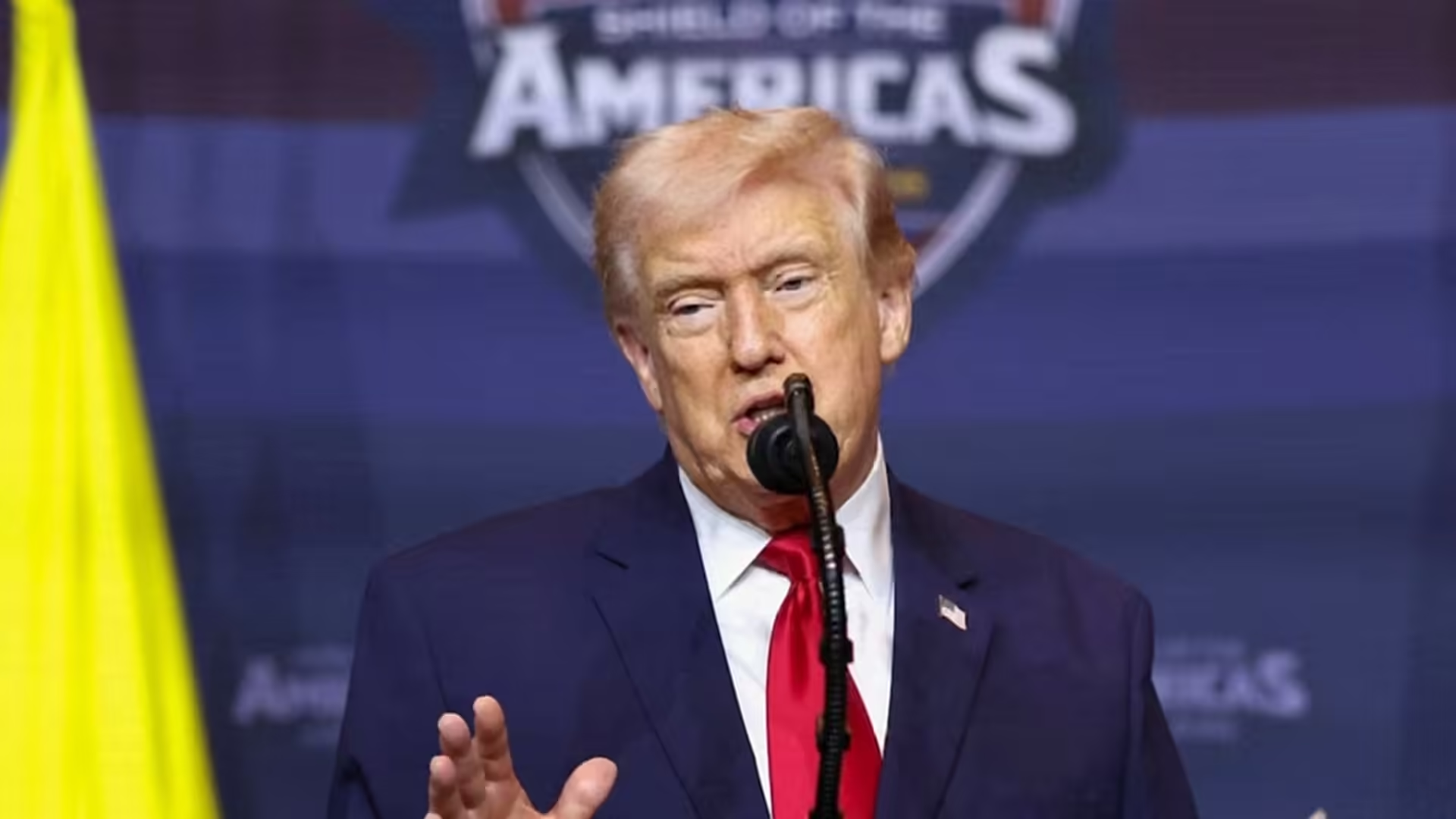
President Donald Trump announced Saturday a new military coalition aimed at combating drug cartels in Latin America during the Shield of the Americas summit held at his golf club in Doral, near Miami, Florida.
The summit brought together 12 right-aligned leaders from the region, including Argentina's Javier Milei, El Salvador's Nayib Bukele, Ecuador's Daniel Noboa, Bolivia's Rodrigo Paz, Honduras's Nasry Asfura, Paraguay's Santiago Peña, Costa Rica's Rodrigo Chaves, Panama's José Raúl Mulino, Dominican Republic's Luis Abinader, and Guyana's Irfaan Ali. The gathering notably excluded countries with progressive governments, including Mexico, Brazil, and Colombia.
During his inaugural address, Trump declared the formation of what he called a "new military coalition to eradicate the criminal cartels that plague our region." He signed an executive order to formalize the coalition. Trump stated that the coalition's core commitment was "the use of lethal military force to destroy" the cartels, adding, "Once and for all, we will get rid of them. We need your help. You just have to tell us where they are."
Secretary of State Marco Rubio, who addressed the assembled leaders in Spanish, praised Trump's commitment to the initiative. Rubio, of Cuban descent, thanked the attending presidents and commended the Republican president's follow-through on his stated objectives.
Trump accused Mexico of being "the epicenter of cartel violence in Latin America" during his speech. However, he also described Mexican President Claudia Sheinbaum as "a very good person." Trump reiterated that criminals control Mexico and that they must be "eradicated" to ensure U.S. security.
The summit addressed multiple regional concerns. Trump stated that this week the United States formally recognized the government of Delcy Rodríguez in Venezuela, restoring diplomatic relations between the two nations following a U.S. military operation that resulted in the capture of Venezuelan President Nicolás Maduro on January 3. Trump said he was "pleased" to announce the formal recognition, which he described as having been done "legally."
Regarding Cuba, Trump asserted that the regime is "in its last moments of life as we know it" and stated that Havana "wants to reach an agreement" in negotiations with him and Rubio. He also said Cuba would have "a great new life."
Trump warned that he would "not allow foreign interference" in the Panama Canal, addressing concerns about external influence in the strategic waterway.
The summit was framed within what the Trump administration calls the "Donroe Doctrine," described as a modern interpretation of the historical Monroe Doctrine. According to officials, the doctrine emphasizes that the United States should be the hegemonic power in the Western Hemisphere and aims to counter Chinese influence in the region while addressing organized crime and illegal immigration.
During remarks to the assembled leaders, Trump stated he would not learn Spanish, saying, "I'm not going to learn your damn language. I don't have time." He noted that Rubio possessed a "linguistic advantage" due to his fluency in Spanish and joked about his own lack of language skills.