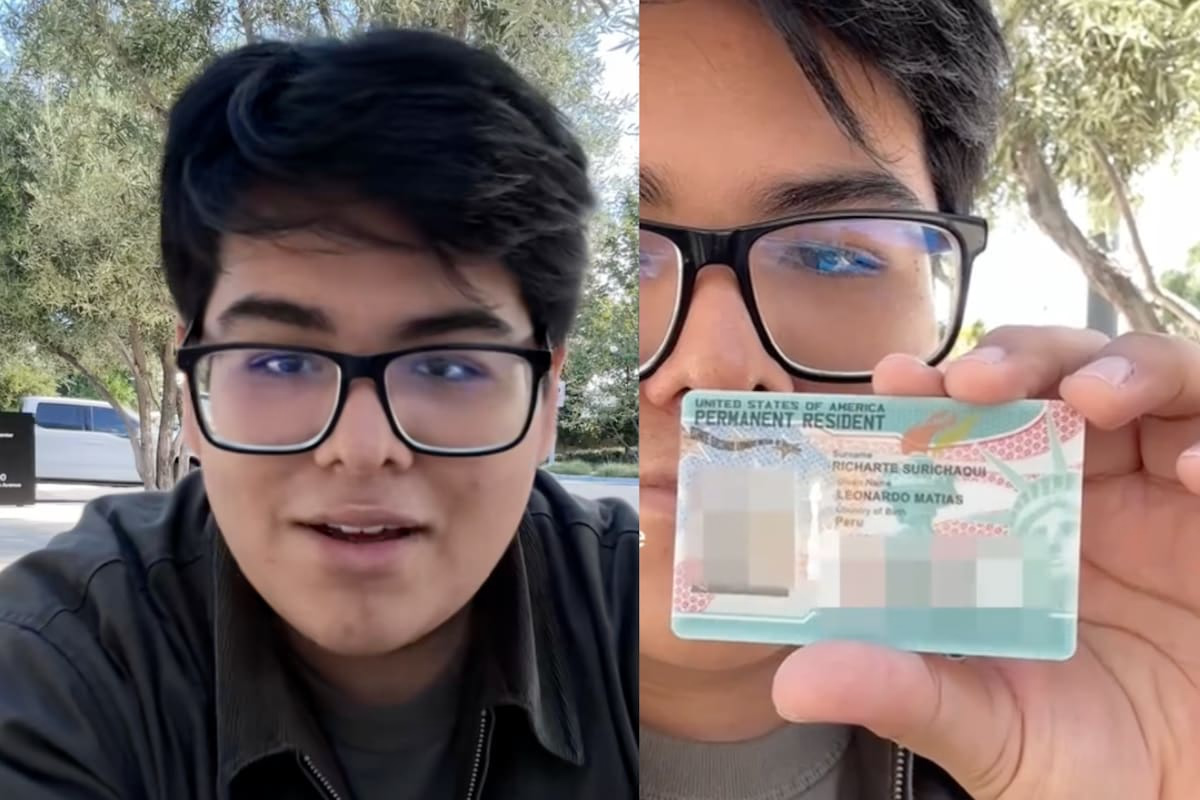
A Peruvian digital creator has shared his experience navigating the U.S. immigration system, successfully transitioning from a J-1 visa to obtaining a green card.
Leonardo Richarte, who was participating in the Work and Travel program in New York on a J-1 visa, received an unexpected notification from the U.S. embassy. He was invited for a consular interview for the Diversity Visa Program, an annual lottery system that grants permanent residency in the United States.
Richarte recounted in a TikTok video that he applied for the green card lottery in October 2023. He explained the low odds of selection, noting that out of approximately 10 million applicants, only about 50,000 receive residency. Official data from the U.S. Department of State for that year indicated 19,927,656 valid entries and 131,060 pre-selected individuals, with around 51,350 permanent resident visas ultimately issued.
In mid-May 2024, Richarte learned he had been pre-selected for the diversity visa process. By November, he received a summons for a consular interview in Peru scheduled for January 2025. At that time, he was already planning to be in the U.S. on his J-1 visa for the Work and Travel program. This presented a logistical challenge, as he had to inform his agency about the need to travel mid-program.
His sponsor initially expressed reservations about his return. Richarte explained that an alternative was proposed: his sponsor would speak with his employer to reduce his work hours, potentially allowing him to travel to the U.S. in December on the J-1 visa. Ultimately, his employer agreed to his conditions, and he was able to finalize arrangements.
On January 30, 2025, Richarte flew from New York to Lima for his consular interview. "I had to take a risk for a visa I didn't know if I would get, but fortunately, they gave it to me," he stated.
Following his approval, he returned to the United States on February 14, 2025. He landed in New York and then traveled to Lake Placid, arriving during a snowfall. He described feeling at home again upon his return.
Richarte also outlined the eligibility requirements for the Diversity Visa Program. He mentioned that applicants must be born in an eligible country and possess a high school education or equivalent, or have at least two years of work experience in a qualifying field. The application process can be completed without intermediaries.
As of 2025, a nominal fee of US$1 is required for the application, a change from previous years when it was free, though he noted it remains an economical option. He advised keeping the confirmation number to check results in May 2026.
Richarte clarified that applying for the diversity visa does not affect other visa applications. He successfully obtained his J-1 visa after completing the DS-260 form. However, he cautioned that individuals on visas with a two-year home residency requirement cannot participate until they fulfill that obligation.
In subsequent updates, Richarte shared details about his life after gaining residency. About a month after starting his kitchen job in Lake Placid, he left on April 29 for Fresno, California, driven by necessity rather than a specific dream. He described his initial experience in Fresno as challenging, marked by dry heat, long distances, and a constant awareness of his changed circumstances.
Less than a month later, on May 18, he decided to move to San Francisco, viewing it as a last resort. He expressed that if this move didn't work out, he would have to return to Lima with debt and unfulfilled dreams. Fortunately, his move proved successful.
Within a few days of arriving in San Francisco, he felt he had found the right place, drawn to the city's hills, public transport, parks, and temperate climate. He is currently living in a shared apartment, walking to work, and studying.
Reflecting on his transition, Richarte stated that he is not the same person who left Lima. He has learned to live independently and to persevere through difficulties. At 20 years old, he works in a restaurant, studies, and shares his migration experiences on social media, concluding that he is pursuing his path for himself.