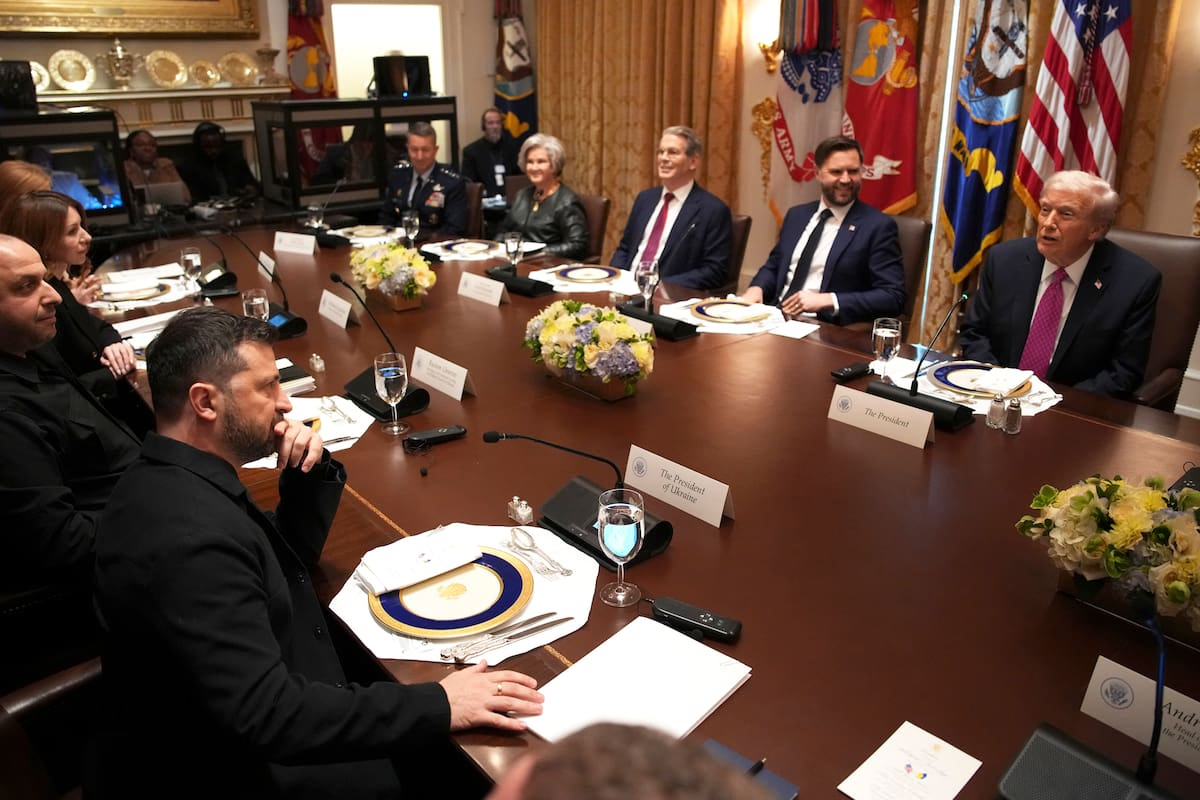
WASHINGTON – U.S. President Donald Trump pushed for an immediate diplomatic settlement to the war in Ukraine during a meeting with President Volodímir Zelenski on Friday, urging both Kyiv and Moscow to cease hostilities on the current front lines.
Following the White House meeting, President Trump expressed reluctance to provide Ukraine with the long-range Tomahawk missiles Zelenski had requested, characterizing such a move as a potential escalation and emphasizing the need to preserve U.S. weapons reserves.
“It is time to stop the killing and reach a deal,” Mr. Trump wrote on social media after the talks. He stated he had strongly suggested the same measure to Russian President Vladimir Putin. “Enough blood has been spilled, and the territorial borders have been defined by war and courage. They should stop where they are. Let both claim victory, let history decide!”
Missile Request Denied Amid Escalation Fears
Mr. Zelenski traveled to Washington seeking the advanced Tomahawk missiles, which Ukrainian forces believe are necessary to strike deeper into Russian territory and target military and energy infrastructure, thereby forcing Moscow into serious negotiations. Zelenski presented a proposal where Ukraine could supply its advanced drones to the U.S. in exchange for the long-range missiles.
Mr. Trump acknowledged the Ukrainian leader’s needs but held firm, expressing concern about depleting U.S. military stock. “We have many, but we need them. I mean, we cannot exhaust our country’s reserves,” he said.
The American leader indicated that while the Tomahawks are “great weapons” and the threat of using them exists, he preferred the war to end without their deployment to avoid escalation. Ukraine’s Foreign Minister, Andrii Sybiha, suggested that simply discussing the potential transfer of Tomahawks had already pressured Moscow toward dialogue, noting, “Force can truly push peace.”
Putin Warns Against Weapon Transfer
The meeting came a day after Trump held a lengthy telephone conversation with Putin, which the U.S. president described as “productive.” During that call, Mr. Putin reportedly warned that supplying Tomahawks to Kyiv would inflict “substantial damage to the relationship between our countries” and would not alter the situation on the battlefield.
Mr. Trump described himself as a mediator, expressing optimism that peace was attainable. “I believe President Zelenski wants it done, and I believe President Putin wants it done,” he noted. The Ukrainian president praised Trump for his recent role in securing a Gaza ceasefire and urged him to use that diplomatic “momentum” to resolve the conflict in Europe.
While Zelenski confirmed that the conversation regarding long-range weapons and Ukrainian air defenses was “productive,” he declined to comment further, saying Washington “does not want an escalation.”
Mr. Trump confirmed that he and Mr. Putin plan to meet in Budapest in the coming weeks, a summit he clarified would be bilateral, not trilateral, noting that the Russian and Ukrainian leaders “hate each other.”
Bering Strait Tunnel Interest
In a highly unusual exchange during the meeting, Mr. Trump showed interest in a separate proposal floated by Russian officials: a submarine tunnel connecting the U.S. state of Alaska to Russia.
Reporters asked Trump about the concept, which had been raised by Kirill Dmitriev, an investment envoy for President Putin and director of the Russian sovereign wealth fund RDIF, in discussions with billionaire Elon Musk.
“A tunnel from Russia to Alaska. That is interesting,” Trump remarked, turning to Zelenski to ask his opinion. The Ukrainian leader, whose nation has been fighting a full-scale Russian invasion for over three years, replied curtly: “I am not happy with that,” prompting laughter from his host.
Russian officials suggested the project, potentially undertaken using technology from Musk’s Boring Company, could create an 112-kilometer connection under the Bering Sea for less than $8 billion. The idea of linking the continents across the Bering Strait, which is only 82 kilometers wide at its narrowest point, reportedly dates back to the Cold War era. However, experts noted that vast infrastructure would also be required in Russia's sparsely populated Chukotka region to make such a link viable.