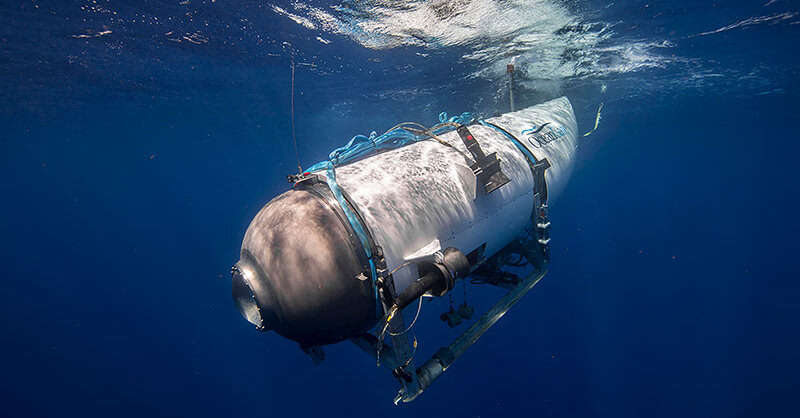
Federal investigators have determined that faulty engineering and undetected damage sustained during previous dives were the primary causes of the Titan submersible's catastrophic implosion, which resulted in the deaths of all five people aboard during a 2023 expedition to the Titanic wreckage.
The National Transportation Safety Board (NTSB) released its final report on Wednesday, concluding that OceanGate, the company that owned and operated the submersible, failed to adequately test the Titan and was unaware of its true strength and durability. The vessel "failed to meet necessary strength and durability requirements," the report stated.
The experimental submersible, made from carbon fiber composite instead of the titanium used in other deep-sea vessels, lost contact with its support ship on June 18, 2023, about an hour and 45 minutes into its dive to the Titanic, which lies approximately 12,500 feet below the surface of the North Atlantic.
According to the NTSB report, earlier dives had caused damage to the hull, including delamination, which went undetected by OceanGate. The report also indicated that the company's real-time monitoring data was flawed, leading to a failure to remove the Titan from service after its 80th dive, even though the fatal dive was the 88th.
"The existing delaminations and additional damage that deteriorated the condition of the pressure vessel between dive 82 and the casualty dive (dive 88) resulted in a local buckling failure that led to the implosion of the Titan," the NTSB said.
The five individuals who perished were OceanGate founder and CEO Stockton Rush; British billionaire Hamish Harding; French maritime expert Paul-Henri Nargeolet; Pakistani businessman Shahzada Dawood; and his 19-year-old son, Suleman Dawood.
Search efforts for the submersible spanned four days before its wreckage was discovered. The NTSB report noted that while finding the submersible sooner would not have saved the lives aboard, adhering to established emergency response plan guidance could have led to its discovery more quickly, thus saving time and resources.
The NTSB's findings echo those of a U.S. Coast Guard report released in August, which also deemed the disaster preventable and described OceanGate's safety procedures as "critically flawed" with "glaring disparities" between protocols and actual practices. The Coast Guard report also alleged that OceanGate used "intimidation tactics" to avoid regulatory scrutiny.
OceanGate suspended operations in July 2023 and has since wound down. The company has not commented on the latest NTSB report.
In its recommendations, the NTSB urged the U.S. Coast Guard to establish a panel of experts to study the safety of submersibles and other human-occupied pressure vessels. It also called for the Coast Guard to develop new regulations based on these findings and share them with the private exploration industry, which has seen significant growth.
Lawsuits have been filed against OceanGate. The family of Paul-Henri Nargeolet filed a wrongful death suit last year, alleging gross negligence. Separately, Marc and Sharon Hagle sued Stockton Rush, claiming they were misled about a planned trip to the Titanic and denied a refund, a suit they later dropped after the accident.
The NTSB report highlights that current regulations and voluntary guidance for small passenger vessels "enabled OceanGate's operation of the Titan in an unsafe manner."