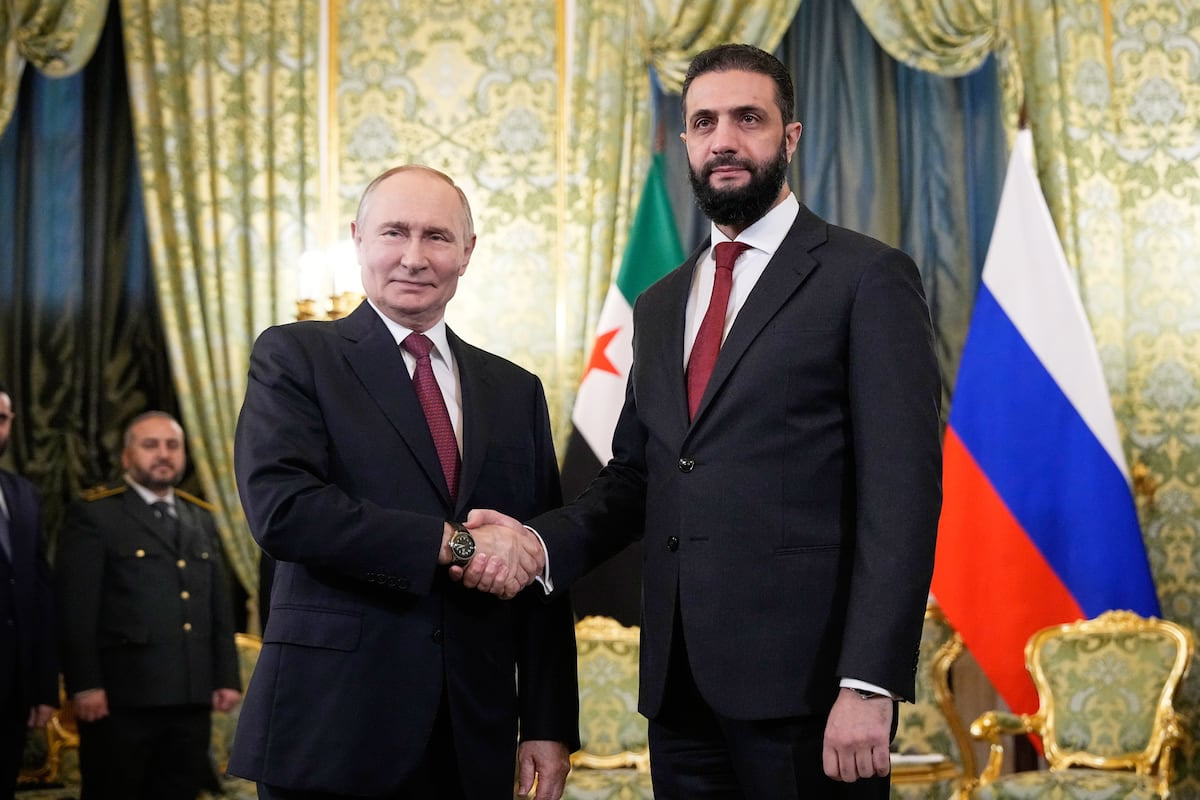
MOSCOW – Russian President Vladimir Putin extended a warm welcome to Syria's new leader, Ahmed al-Shara, at the Kremlin on Wednesday, a striking development given that Russia is currently hosting the toppled predecessor and adversary of the Syrian president, Bashar al-Assad.
The meeting signals a clear intention from both leaders to forge a new path in the relationship between Moscow and Damascus. During Syria's prolonged civil conflict, Mr. Putin had been a staunch supporter of Mr. al-Assad. However, his regime ultimately fell in December 2024 to rebel forces led by Mr. al-Shara.
For Mr. al-Shara, a former member of Al Qaeda who once led rebel forces under intense Russian airstrikes, the meeting represents a considerable victory. Despite Russia's past backing of Mr. al-Assad, Mr. Putin received Mr. al-Shara in a grand Kremlin hall, a calculated gesture aimed at preserving Moscow's long-standing military bases in Syria.
"Dear President! We are pleased to welcome you to Moscow," Putin stated upon greeting the now suit-clad former jihadist. He emphasized what he described as "special relations" that have developed over decades, without specifically detailing the historical alliance with the al-Assad dynasty dating back to Soviet times. Putin justified Russia's past actions by saying, "Russia has never had relations with Syria tied to our political circumstances or special interests. We have always been guided by the interests of the Syrian people," he told the leader of the rebels who deposed al-Assad.
A key point of discussion during the talks was the future of Russian military bases in Syria, located at the port of Tartus and the Hmeimim air base. These facilities are crucial for the Kremlin's projection of influence in the Middle East and Mediterranean, and support its mercenary forces in Africa. The stability of these bases became uncertain after the fall of al-Assad in December 2024. Russia, which heavily supported the previous regime and whose air forces targeted civilians and rebels after Moscow's 2015 intervention, has confirmed it is negotiating their future with the new Syrian leadership.
"Obviously, this issue will be addressed in one way or another during the conversation," had stated Putin's spokesperson, Dmitri Peskov, prior to the meeting. The significance of these bases on al-Shara and Putin's agenda was underscored by the presence of not only the Russian leader, his Foreign Minister Sergey Lavrov, and advisors, but also the military high command, including Defense Minister Andrei Belousov and top military officials.
Mr. al-Shara assumed control of the Syrian republic less than a year ago, following the swift departure of his predecessor, Bashar al-Assad. Sources within Syria have indicated that the new Syrian leader intends to press the Kremlin during his visit for the extradition of alleged war criminals living in Russia, particularly al-Assad.
Reports from German newspaper Die Zeit suggest that the former Syrian dictator is residing in an apartment near the Kremlin in Moscow's financial district, reportedly spending his days playing online video games. The newspaper also stated that over a thousand of his associates fled to Russia after the collapse of his regime.
The new Syrian president previously led the Salafist group Hayat Tahrir al-Sham (HTS). This organization, along with the Syrian National Coalition, the primary opposition platform, overthrew a dictatorship that had been in power since 1971, when Hafez al-Assad, Bashar's father, first came to power, with support from Turkey.
In a television interview, Mr. al-Shara expressed his intention to strengthen ties with China and Russia, while remaining open to cooperation with Western countries. His official visit to Moscow solidifies this renewed dialogue between Damascus and Moscow, following a visit by the Syrian Foreign Minister, Assad al-Shirbani, in July. For the Kremlin, legitimizing the former jihadist leader may not prove difficult, especially after Russia recently removed the Taliban from its list of terrorist organizations, reclassifying them as an ally.
President Putin also praised Syria's parliamentary elections held the previous week, which proceeded without the participation of opposition groups like the Druze and Kurds. "Despite the fact that Syria is currently going through difficult times, these [parliamentary elections] will strengthen ties and interactions between all political forces in Syria. I believe this is your great success," Putin remarked.