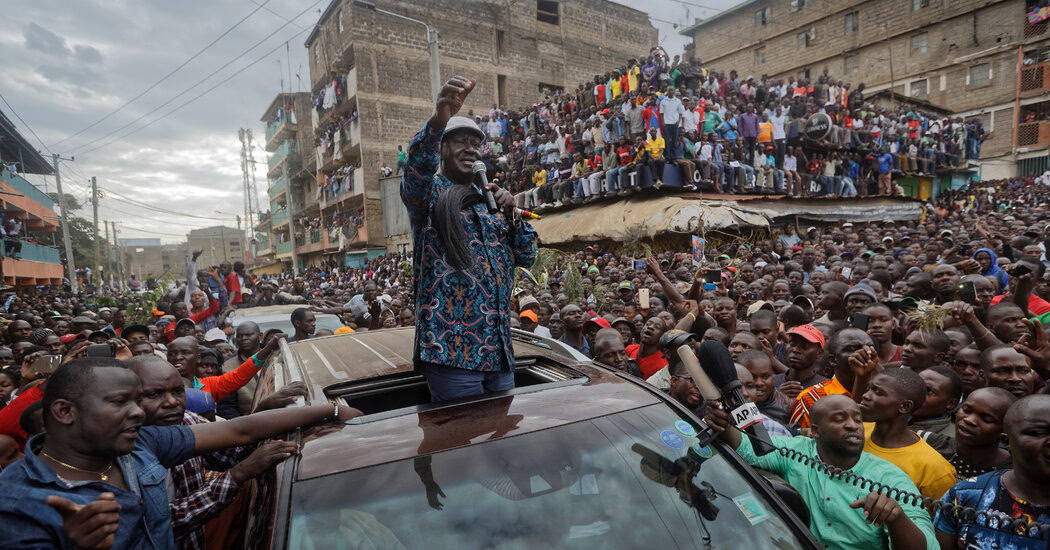
Raila Odinga, a dominant and influential figure in Kenyan politics for decades, has died at the age of 80. The former Prime Minister passed away on Wednesday in Kerala, India, after suffering a cardiac arrest during a morning walk, confirmed Devamatha Hospital.
Regarded as one of Kenya's most significant political personalities, Odinga's career spanned over four decades, during which he played a crucial role in shaping the nation's modern democracy. He ran for the presidency five times without success, including in the contentious 2007 election that led to widespread ethnic violence, resulting in nearly 1,000 deaths.
Kenya's President William Ruto announced Odinga's death in a televised address, declaring seven days of national mourning and a state funeral. Ruto paid tribute to Odinga as a "father of our democracy" and a "giant" of Kenyan politics, noting his "indomitable warrior in our struggle for freedom and prosperity."
Despite never holding the top office, Odinga was instrumental in dismantling Kenya's one-party rule under Daniel arap Moi in 1992 and championed the progressive 2010 constitution, which introduced significant political reforms. His role as a political power broker was evident in recent months when he forged a political deal with President Ruto following youth-led anti-government protests.
Born in western Kenya in 1945, Odinga commanded a passionate following across the country, from his home region to Nairobi's Kibera, one of Africa's largest slums. His political journey saw him evolve from an anti-establishment figure to a key negotiator, influencing the country's political landscape through periods of both struggle and reform.
Odinga's career began with a scholarship to study in East Germany in the 1960s. After a failed coup attempt in 1982, he was imprisoned for six years without trial. Upon his release, he was a leading voice in protests that pushed for a return to multiparty democracy in Kenya.
He first entered government as Prime Minister in April 2008, following a power-sharing agreement that helped quell post-election violence. He served in this role for five years and continued to be a principal challenger in subsequent presidential elections in 2013, 2017, and 2022, each time alleging that the vote was rigged against him.
In recent years, Odinga's influence was also felt in broader African political spheres. He had recently bid for the chairmanship of the African Union, a position he ultimately did not secure.
Tributes have poured in from across the continent and beyond. The African Union Commission chairperson, Mahmoud Ali Youssouf, described Odinga as a "towering figure in Kenya's political life and a steadfast champion of democracy, good governance and people-centered development," adding that "Africa has lost one of its most visionary sons."
Prime Minister Narendra Modi of India called Odinga "a towering statesman and a cherished friend of India." Odinga's daughter, Rosemary, had previously sought treatment at the same ayurvedic hospital in Kerala.
In Kenya, thousands took to the streets in Odinga's political stronghold of Kisumu to mourn his passing, with many describing him as a "hero."
A delegation led by the Orange Democratic Movement party's secretary general was en route to India to retrieve Odinga's body. The party described him as "a true giant of the nation and a darling in the hearts of Kenyans."