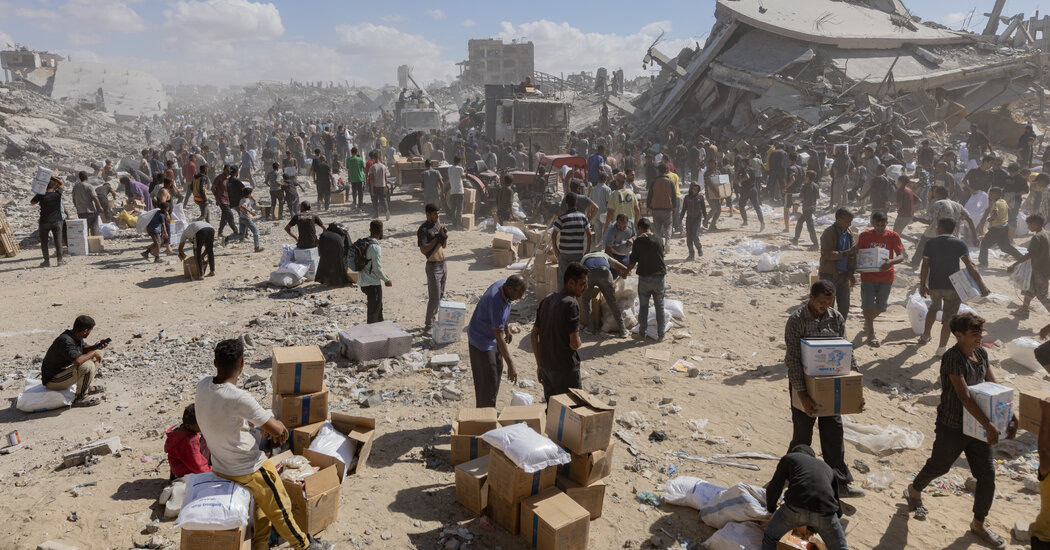
The United Nations estimates that the recovery and reconstruction of the Gaza Strip, devastated by two years of war with Israel, could take decades and cost at least $70 billion (approximately R$ 382 billion).
This projection, released on Tuesday, is over 30% higher than the $53 billion (R$ 306.2 billion) anticipated by the UN in a report from March.
According to the UN, Arab nations, the European Union, Canada, and the United States have indicated a willingness to contribute to the financing. During a summit on Monday to sign a peace agreement for Gaza, U.S. President Donald Trump mentioned positive financial support from European partners and Canada, adding that discussions with the U.S. were ongoing.
Jaco Cilliers, a representative from the UN Development Programme (UNDP), stated that the conflict generated approximately 55 million tons of debris, a volume of rubble equivalent to 13 times the size of the pyramids of Giza. The UNDP has already removed about 81,000 tons of debris from Gaza and continues its cleanup operations.
Significant destruction is concentrated in Gaza City, the territory's capital, which experienced some of the most intense bombing. According to the UN Satellite Centre (Unosat), more than 80% of all buildings in Gaza's largest urban center have been damaged.
The UN plans to map reconstruction priorities, with $20 billion (R$ 115.4 billion) required in the next three years. "Not all sites can be rebuilt immediately," Cilliers noted, emphasizing that ensuring the supply of materials for water and sanitation services will be a priority.
Since the cease-fire agreement between Hamas and Israel took effect on Friday, Israeli troops have withdrawn, and displaced Palestinians have begun returning to their homes. On Monday, as part of the peace plan, the final 20 living hostages held by Hamas were released, and Israel freed nearly 2,000 Palestinian prisoners.
Questions remain regarding the next steps of the agreement, including the disarmament of Hamas, the reconstruction of Gaza, and the specific structure of a technocratic government for the Palestinian territory. These points are part of Donald Trump's peace plan, which has been approved by both Israel and Hamas leadership and endorsed by mediating countries such as Egypt, Turkey, and Qatar.
While Trump has championed the reconstruction efforts, he has remained ambiguous about recognizing a Palestinian state, focusing instead on Gaza's rebuilding. The White House has committed to ensuring stability in the region as part of the peace agreement.