Pope Leo XIV presented his first encyclical Monday, titled "Magnifica Humanitas" (Magnificent Humanity), addressing the risks of artificial intelligence and calling on political and business leaders to protect humanity from the technology's most disruptive effects.
The 42,300-word document, signed May 15 and presented at the Vatican, frames AI as a new industrial revolution comparable to the technological upheaval addressed by Pope Leo XIII in his 1891 encyclical "Rerum Novarum." The new encyclical is addressed to all Catholics, all Christians, and all people of good will, with a stated focus on safeguarding the human person in the age of artificial intelligence.
Pope Leo XIV warned that artificial intelligence is not neutral and risks concentrating power in the hands of a few private companies. He called for AI to be "disarmed"—removed from military and economic interests—and subjected to stricter regulation and ethical oversight. The pontiff stated that artificial intelligence threatens to normalize an anti-human vision and could widen inequality, weaken democracy, and undermine what it means to be human.
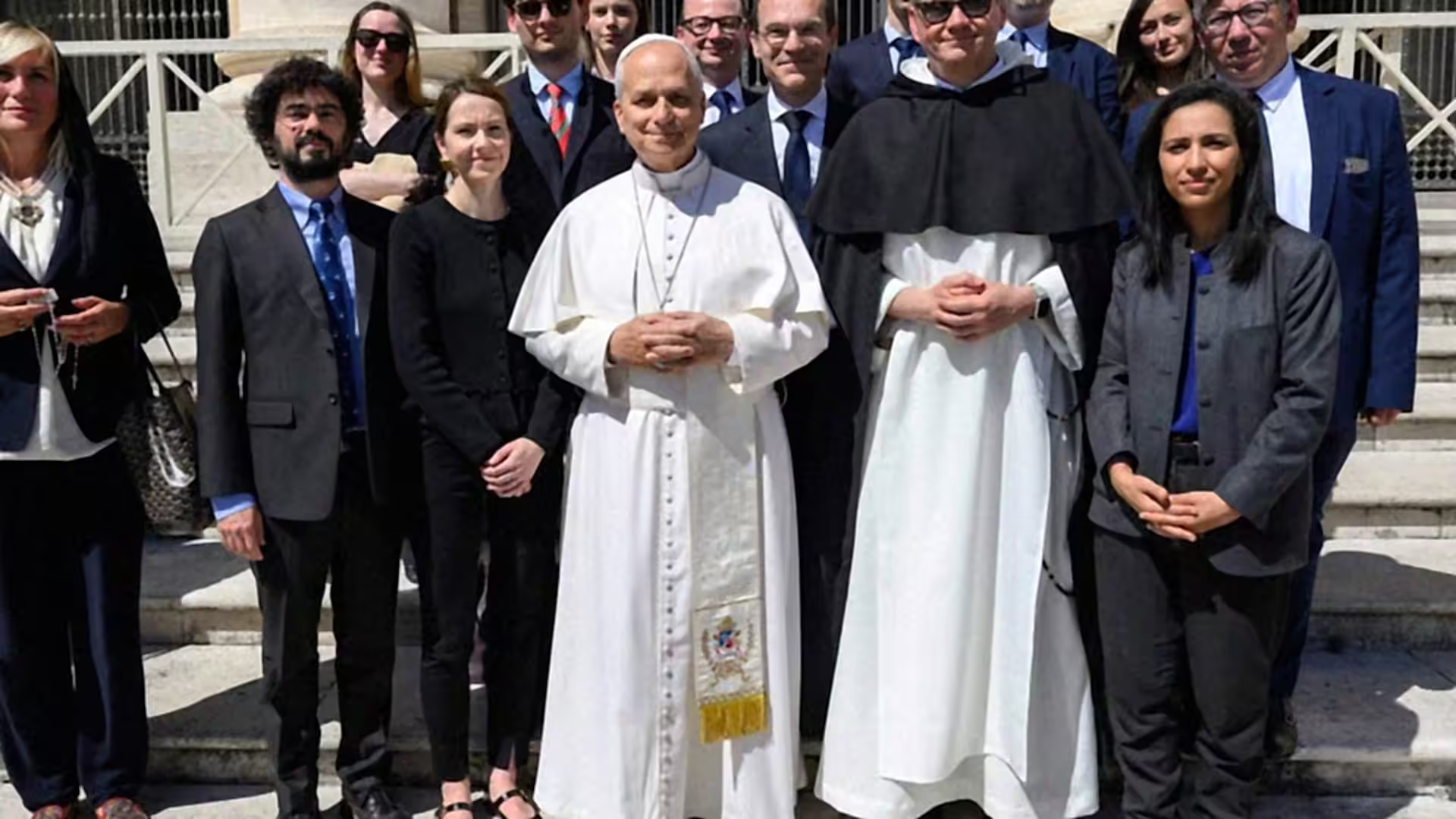
In a symbolic gesture of dialogue between religious and technological worlds, Christopher Olah, co-founder of Anthropic, one of the world's leading AI development companies, attended the encyclical's presentation at the Vatican. This marked the first time a pope was present at the publication of a papal document.
The encyclical draws a comparison between AI and nuclear energy, arguing that like nuclear power, artificial intelligence must serve all people and the common good rather than remain under private control. Pope Leo XIV called for robust regulation, appropriate legal frameworks, just rules, and effective protection mechanisms in the digital age.
In paragraph 213, the encyclical references J.R.R. Tolkien's "The Lord of the Rings," citing one of the character Gandalf's most famous speeches to argue about technology's power over work and the risk of dehumanization. Tolkien is identified in the text as a 20th-century Catholic writer.
The document also addresses other social issues. Pope Leo XIV issued a formal apology for the Vatican's historical role in facilitating and justifying the transatlantic slave trade, calling it "a wound in Christian memory." He stated that the Church had delayed in condemning slavery and acknowledged that previous popes had granted European sovereigns explicit authority to subjugate and enslave people.
On the question of military conflict, Pope Leo XIV wrote that the "just war" theory, which has been used to justify various wars, is now outdated. He stated that without prejudice to the right of self-defense in the strictest sense, it is important to reaffirm that just war theory can no longer serve as justification for any kind of war. The pontiff has previously clashed with the Trump administration over the Iran war and some U.S. officials' religious justifications for it.
The encyclical also addresses the role of culture and art in preserving human dignity. Pope Leo XIV cited Picasso's "Guernica" as having "almost prophetic value" as a denunciation of dehumanization. He also referenced Beethoven's Ninth Symphony as expressing a desire for unity and "Schindler's List" as an invitation not to abandon the past to oblivion. The pontiff emphasized the importance of humans experiencing their limits—vulnerability, pain, and failure—as essential to authentic human experience.
In the months before the encyclical's release, representatives from Meta, Google, and Amazon engaged in what was described as discreet lobbying activity at the Vatican regarding artificial intelligence development. On April 29, representatives from these companies briefly met the pope in Saint Peter's Square, and a lengthy meeting was held at the French embassy to the Holy See where Vatican communications officials discussed the topic with technology company representatives.